To calculate overtime pay, multiply the employee’s regular rate of pay by 1.5, then multiply that by the number of hours they worked over 40 in the workweek. An hourly employee earning $20 who works 46 hours gets $800 for the first 40 hours plus $180 for 6 overtime hours at $30, for $980 total. The tricky part is the “regular rate,” which has to include bonuses, shift differentials and every pay rate the employee earned that week.
Overtime mistakes are one of the most common wage-and-hour problems small businesses run into, and they rarely come from bad intentions. They come from a bonus left out of the math, a second pay rate that was never blended, or a state daily rule nobody knew about. This guide shows you exactly how to calculate overtime pay for every common situation, with worked examples you can copy, plus what changes on your 2026 W-2s because of the new “no tax on overtime” deduction.
Key takeaways
- Federal law requires time and a half (1.5×) the regular rate for every hour a non-exempt employee works over 40 in a workweek.
- The regular rate is total straight-time pay (including most bonuses and differentials) divided by total hours worked, not just the base hourly wage.
- Overtime is counted per 7-day workweek. You can’t average two weeks of a biweekly pay period together.
- Some states add daily overtime: California, Alaska, Nevada and Colorado all have rules beyond the 40-hour week.
- Salaried employees are only exempt if they meet a duties test and earn at least $684 per week ($35,568 per year) under federal law.
- For 2026, employers must report qualified overtime compensation (the “half” portion of time and a half) on employees’ W-2s.
What counts as overtime under federal law?
The Fair Labor Standards Act (FLSA) sets the federal overtime rule: non-exempt employees must receive at least one and one-half times their regular rate of pay for all hours worked over 40 in a workweek. The U.S. Department of Labor overtime page covers the full rule, but three details matter most when you sit down to figure out how to calculate overtime pay.
- The workweek is fixed. It’s any recurring period of 168 hours (seven consecutive 24-hour days) that you choose, such as Sunday 12:00 a.m. through Saturday 11:59 p.m. It doesn’t have to match your pay period or the calendar week, but once set, it stays put.
- Each workweek stands alone. If an employee works 50 hours one week and 30 the next, you owe 10 hours of overtime, even though the two-week total is 80.
- “Hours worked” means hours worked. Paid holidays, PTO and sick days usually don’t count toward the 40 under federal law, while required meetings, training and short breaks (typically under 20 minutes) do.
Federal law doesn’t require overtime for working weekends, holidays or more than 8 hours in a single day. Some states do, which we’ll cover below.
How to calculate overtime pay in 3 steps
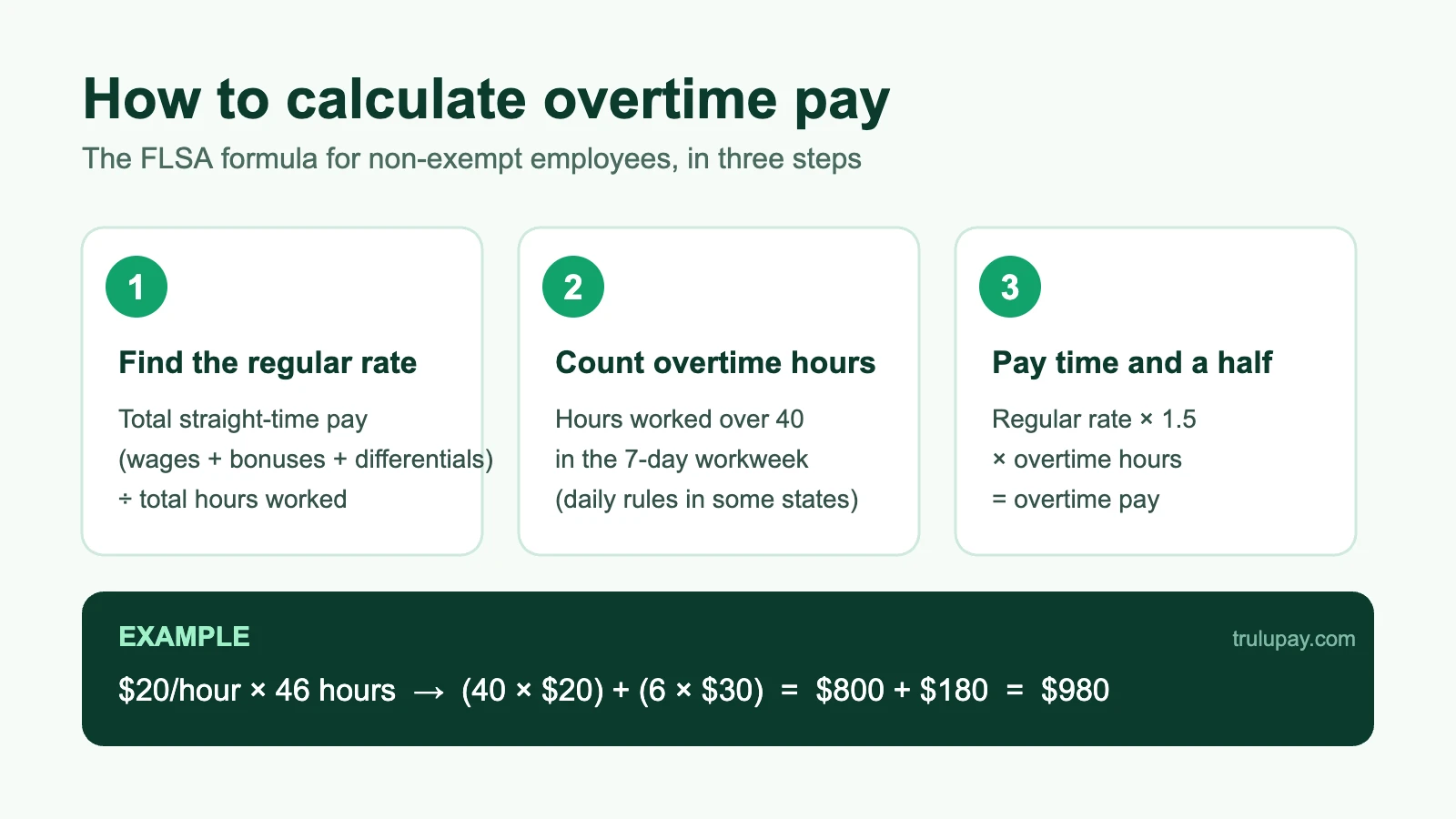
Whether your team is paid hourly, by salary or with a mix of rates and bonuses, the method for how to calculate overtime pay follows the same three steps.
Step 1: Find the regular rate of pay
Add up everything the employee earned for straight-time work during the workweek, then divide by the total hours they worked.
Regular rate = total straight-time pay ÷ total hours worked
For an employee paid one hourly rate with no extras, the regular rate is simply their hourly wage. Once bonuses, commissions or multiple rates enter the picture, you have to do the division.
Step 2: Count the overtime hours
Total the hours worked in the workweek and subtract 40. In states with daily overtime, also check each day against the daily limit and use whichever method gives the employee more overtime hours.
Step 3: Multiply by time and a half
Overtime pay = regular rate × 1.5 × overtime hours
An equivalent way to write it, which you’ll need for blended rates and bonuses, is to pay straight time for all hours and then add a half-time premium: overtime premium = regular rate × 0.5 × overtime hours. Both methods produce the same gross pay when there’s a single hourly rate.
Overtime pay examples for every pay type
Here’s how to calculate overtime pay in the five situations small businesses run into most often. Each example uses a standard 40-hour federal workweek.
Example 1: Hourly employee with one pay rate
Maria earns $20 per hour and works 46 hours this week.
- Regular pay: 40 hours × $20 = $800
- Overtime rate: $20 × 1.5 = $30 per hour
- Overtime pay: 6 hours × $30 = $180
- Total gross pay: $980
Example 2: Employee with two different pay rates
Jordan works 30 hours at the front desk at $18 per hour and 15 hours as a shift lead at $24 per hour, for 45 hours total. The FLSA’s default method is a weighted average of both rates (you can pay overtime at the rate for the work done during the overtime hours only if you agreed to that with the employee before the work was performed).
- Straight-time pay: (30 × $18) + (15 × $24) = $540 + $360 = $900
- Regular rate: $900 ÷ 45 hours = $20 per hour
- Overtime premium: $20 × 0.5 × 5 overtime hours = $50
- Total gross pay: $900 + $50 = $950
Notice you don’t multiply the 5 overtime hours by 1.5 here. The $900 already paid those hours at straight time, so you only add the half-time premium.
Example 3: Hourly employee who earned a bonus
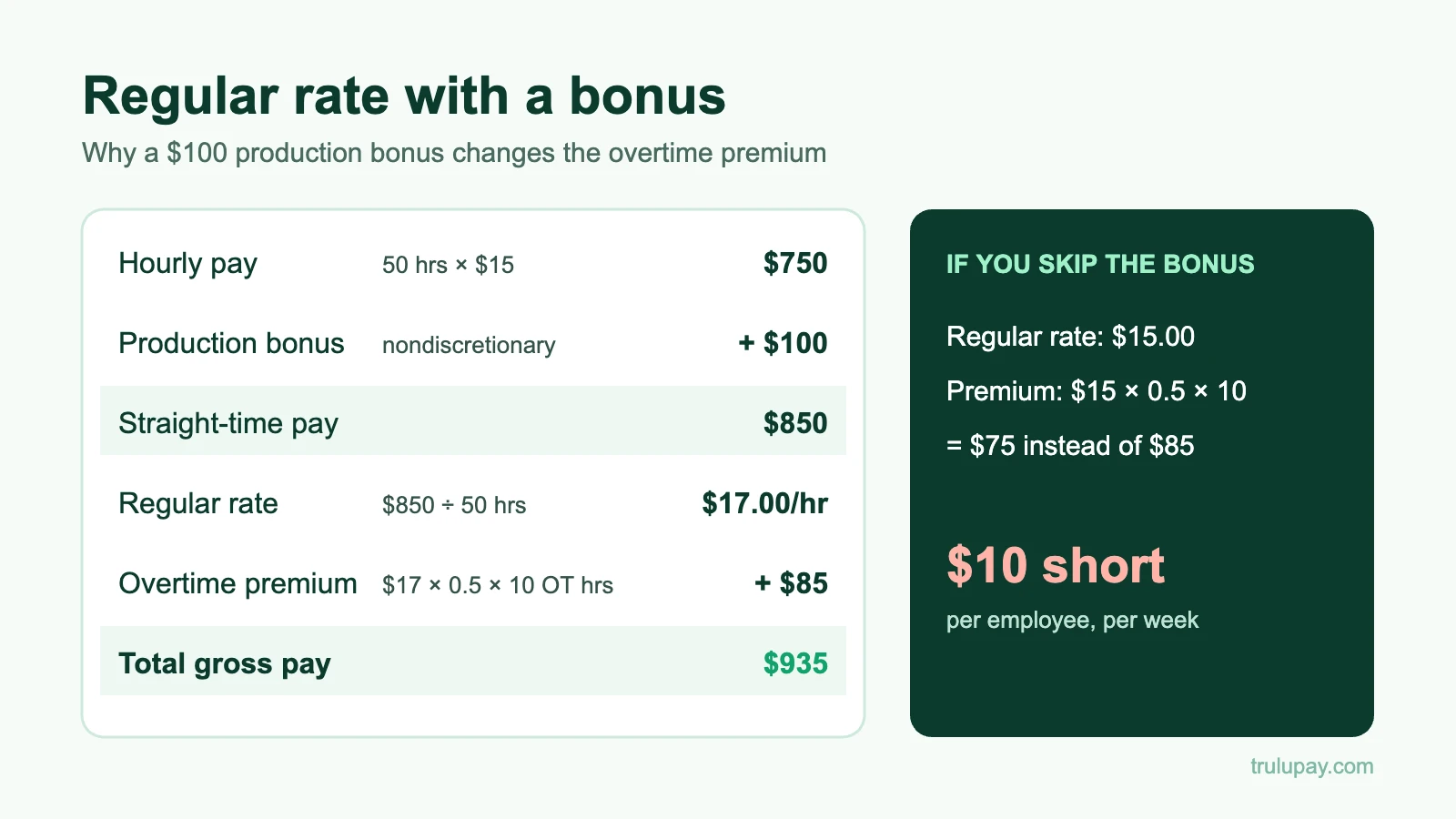
Devon earns $15 per hour, works 50 hours and earns a $100 production bonus for the week. Nondiscretionary bonuses, meaning bonuses promised in advance for hitting a goal, attendance or productivity, must be included in the regular rate. Truly discretionary bonuses, like an unannounced holiday gift, are excluded.
- Straight-time pay: (50 × $15) + $100 bonus = $850
- Regular rate: $850 ÷ 50 hours = $17 per hour
- Overtime premium: $17 × 0.5 × 10 overtime hours = $85
- Total gross pay: $850 + $85 = $935
If you’d ignored the bonus and used $15 as the regular rate, the premium would be $75, and Devon would be underpaid $10 that week. Small gaps like this add up quickly across a team and a year. If a bonus covers more than one workweek, such as a monthly or quarterly bonus, allocate it back across those weeks and recalculate the overtime premium for each one.
Example 4: Salaried non-exempt employee
Not every salaried employee is exempt. Priya earns a $900 weekly salary intended to cover 40 hours and works 44 hours.
- Regular rate: $900 ÷ 40 hours = $22.50 per hour
- Overtime rate: $22.50 × 1.5 = $33.75
- Overtime pay: 4 × $33.75 = $135
- Total gross pay: $1,035
To convert other salary schedules to a weekly amount first: multiply a biweekly salary by 26 and divide by 52, multiply a semimonthly salary by 24 and divide by 52, or multiply a monthly salary by 12 and divide by 52.
Example 5: Employee with a shift differential
Sam earns $16 per hour plus a $2 night-shift differential for 20 of his 42 hours this week. Shift differentials, hazard pay and on-call pay are all part of the regular rate.
- Straight-time pay: (42 × $16) + (20 × $2) = $672 + $40 = $712
- Regular rate: $712 ÷ 42 = $16.95 (rounded)
- Overtime premium: $16.95 × 0.5 × 2 = $16.95
- Total gross pay: $728.95
What to include in the regular rate (and what to leave out)
Most overtime errors happen in Step 1. The DOL fact sheet on bonuses and the regular rate goes deeper, but this table covers what most small businesses pay.
| Include in the regular rate | Exclude from the regular rate |
|---|---|
| Hourly wages and salary | Discretionary bonuses (not promised in advance) |
| Nondiscretionary bonuses (production, attendance, safety, sign-on tied to staying) | Gifts and holiday bonuses not tied to hours or performance |
| Commissions | Pay for unworked time: PTO, holidays, sick leave, jury duty |
| Shift differentials and hazard pay | Expense reimbursements for business costs |
| On-call pay | Employer contributions to retirement, health and benefit plans |
| Retention and referral bonuses tied to work requirements | Premium pay already at 1.5× for weekend or holiday work |
State overtime laws that change the math
Federal law is the floor. When a state law is more generous, you follow the state rule. Before you finalize how to calculate overtime pay for your team, check the rules where each employee physically works.
| State | Daily overtime rule | Other rules to know |
|---|---|---|
| California | 1.5× after 8 hours in a workday; 2× after 12 hours | 1.5× for the first 8 hours on the 7th consecutive workday, 2× after 8 hours that day |
| Alaska | 1.5× after 8 hours in a day | Applies to employers with 4 or more employees |
| Nevada | 1.5× after 8 hours in a 24-hour period | Only for employees earning under 1.5× the state minimum wage, unless on an agreed alternative schedule |
| Colorado | 1.5× after 12 hours in a workday or 12 consecutive hours | Weekly 40-hour rule also applies |
| All other states | None (federal 40-hour weekly rule) | Several states set higher salary thresholds for exempt employees |
California overtime example
Lena works four 12-hour days at $20 per hour, 48 hours total. Under California overtime rules, each day has 8 regular hours and 4 daily overtime hours.
- California: (32 × $20) + (16 × $30) = $640 + $480 = $1,120
- Federal-only state: (40 × $20) + (8 × $30) = $800 + $240 = $1,040
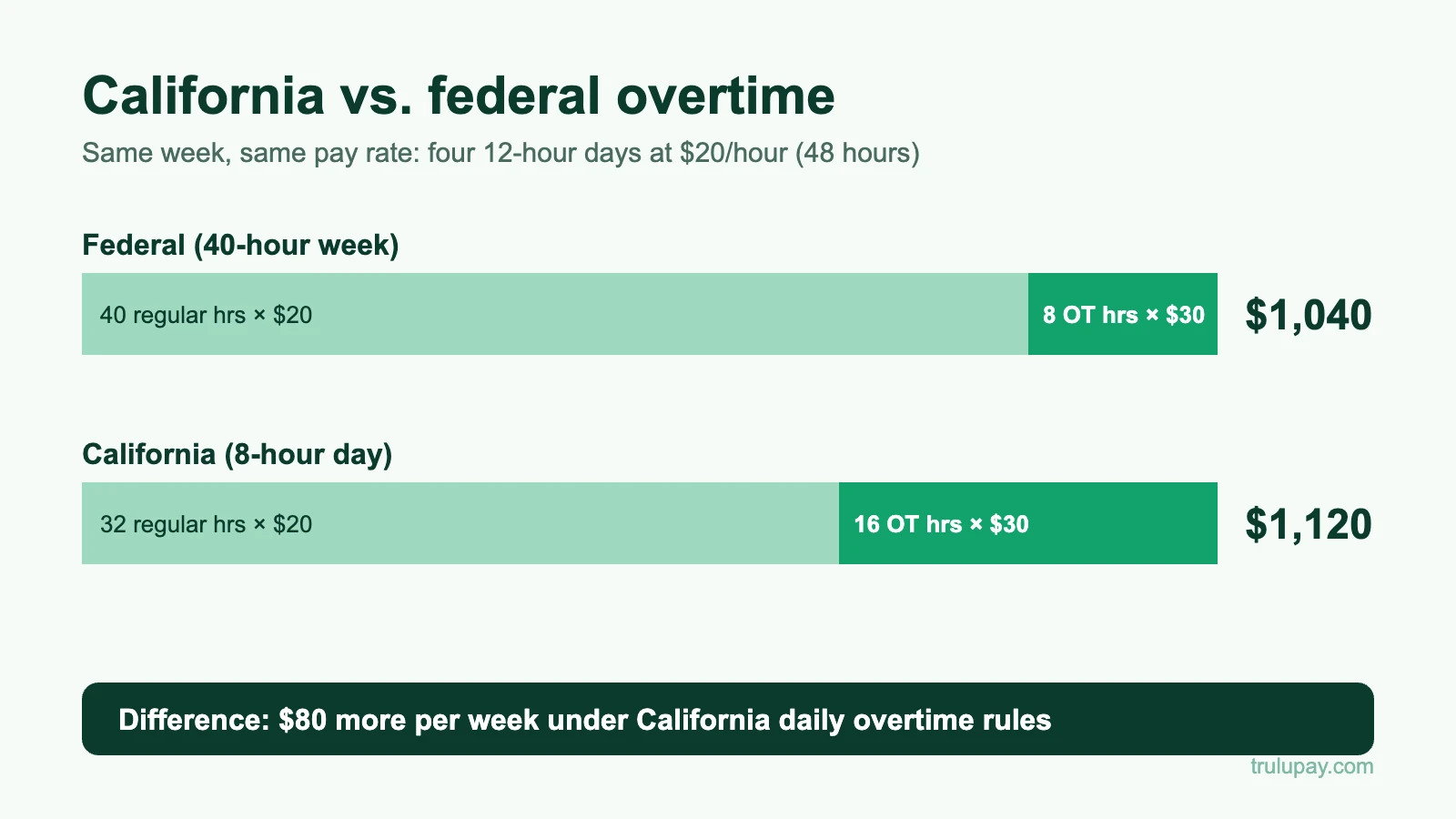
Same hours, $80 difference. Multiply that by a crew and a year, and you can see why knowing how to calculate overtime pay under your state’s rules is worth getting right.
Who is exempt from overtime?
Overtime applies to non-exempt employees. To treat someone as exempt under the FLSA’s executive, administrative or professional exemptions, they generally have to pass all three tests:
- Salary basis: paid a predetermined, fixed salary that isn’t reduced based on the quality or quantity of work.
- Salary level: at least $684 per week ($35,568 per year). The Department of Labor formally restored this threshold in 2026 after courts struck down the 2024 increase. Highly compensated employees must earn at least $107,432 per year.
- Duties: their primary duties fit the exemption, such as managing a department and directing two or more employees, or doing work that requires advanced knowledge in a field of science or learning.
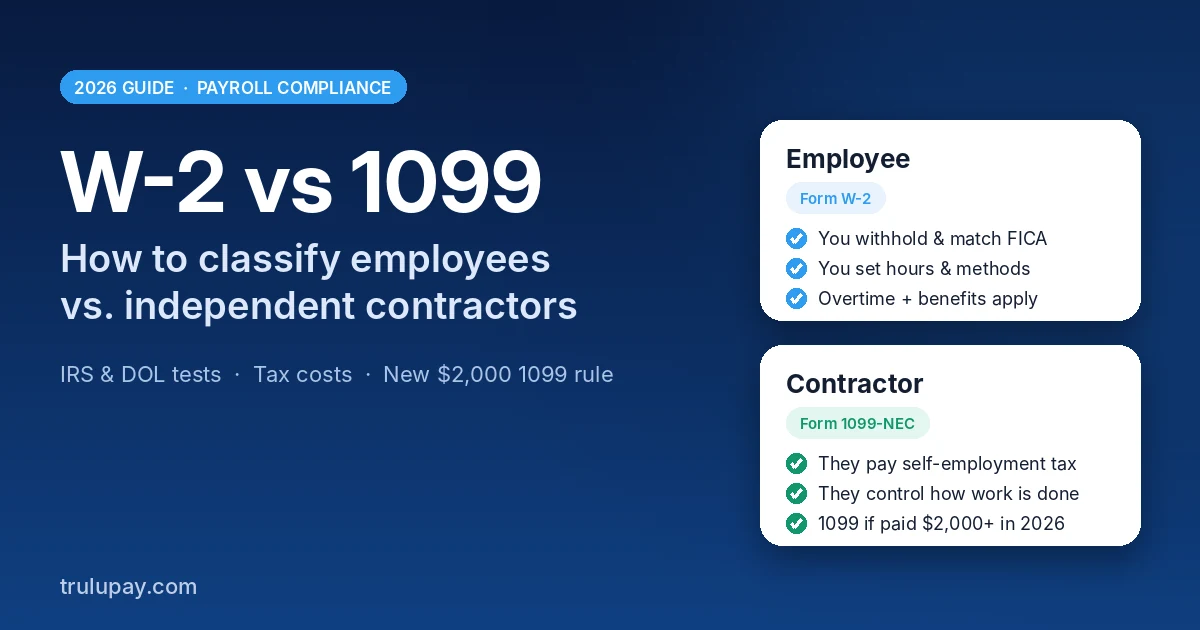
A job title alone never makes someone exempt, and paying a salary doesn’t either. If you’re unsure whether someone should be classified as an employee in the first place, read our guide to W-2 vs 1099 worker classification. Independent contractors aren’t owed overtime, which is exactly why misclassification is so costly when it’s challenged.
2026 update: “no tax on overtime” and your W-2 reporting
The One Big Beautiful Bill Act created a federal income tax deduction for qualified overtime compensation for tax years 2025 through 2028. Employees can deduct up to $12,500 per year ($25,000 for joint filers), and the deduction phases out for incomes above $150,000 ($300,000 joint). The IRS One Big Beautiful Bill provisions page tracks the latest guidance.
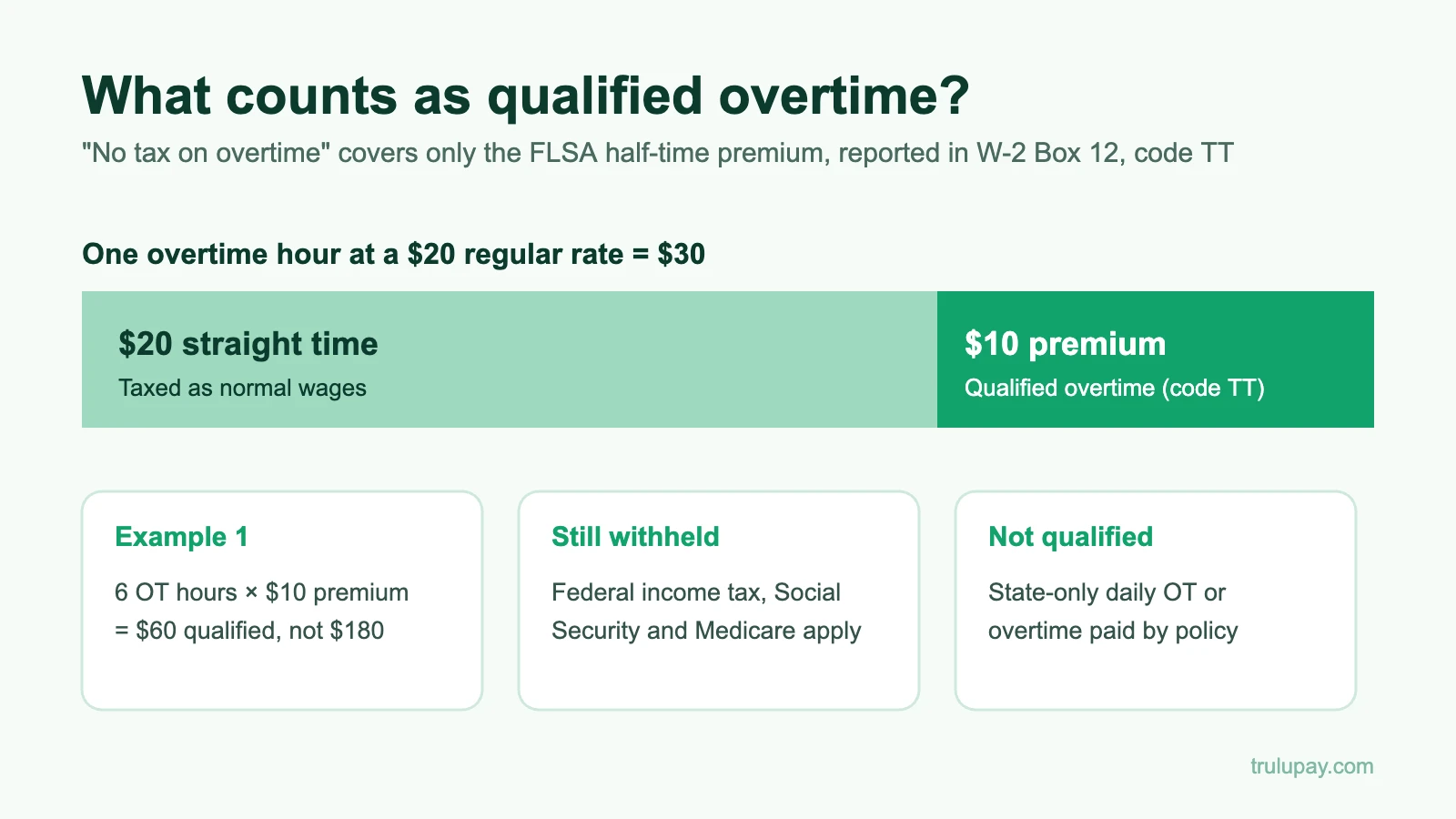
Here’s what it means for you as the employer:
- Your overtime math doesn’t change. You still withhold federal income tax, Social Security and Medicare on all overtime pay. The deduction is claimed by the employee on their own tax return.
- Only the premium counts. “Qualified overtime compensation” is the half-time portion required by the FLSA, not the full time-and-a-half. In Example 1, Maria’s qualified overtime is 6 × $10 = $60, not $180.
- State-only overtime doesn’t qualify. Daily overtime required only by state law, or overtime paid by company policy, isn’t FLSA-required, so it isn’t reported as qualified overtime.
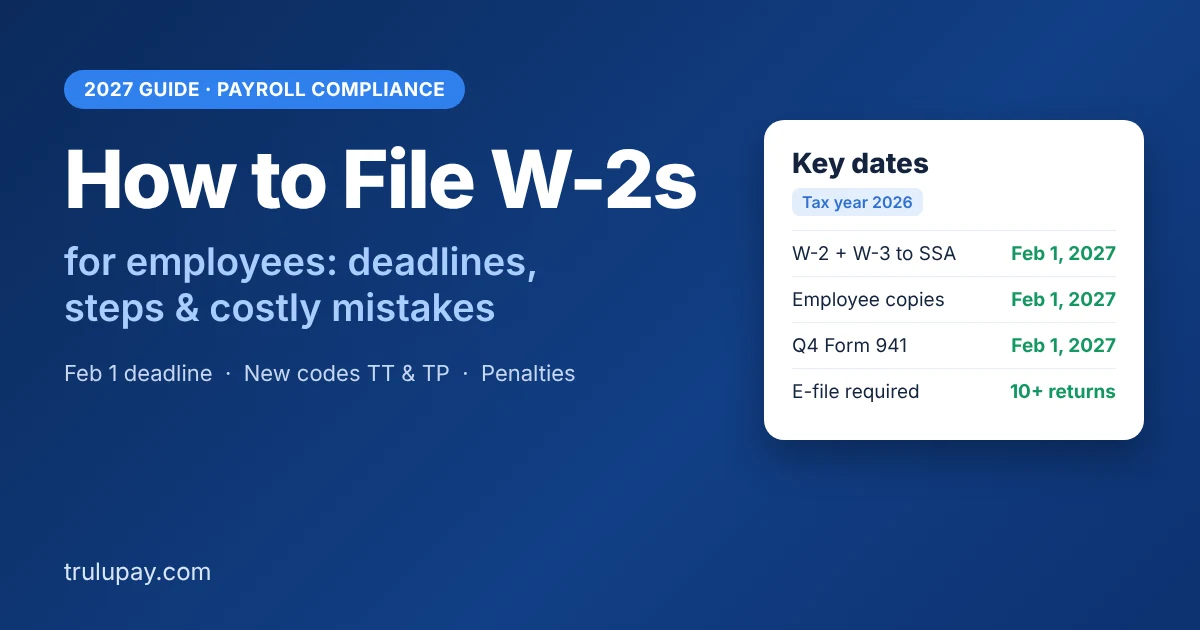
- New W-2 reporting. For 2026, report qualified overtime compensation in Box 12 with code TT. That means your payroll system needs to track the FLSA premium separately from the rest of overtime pay.
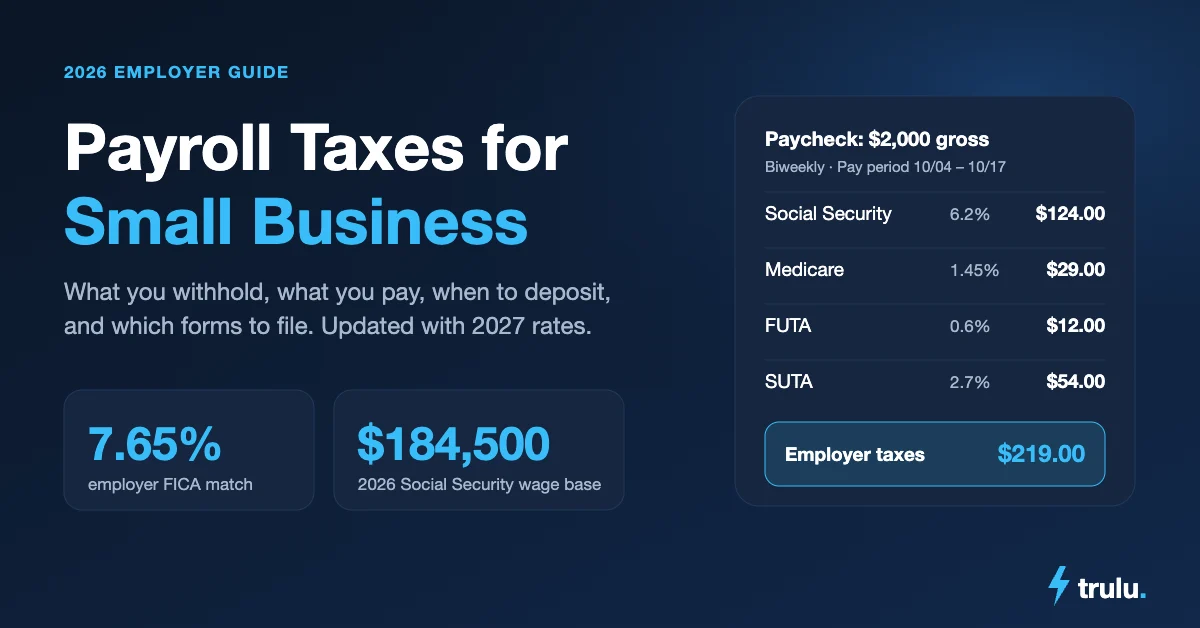
If you’re preparing for year-end now, our guide to payroll taxes for small business walks through withholding and filing, and our 2027 payroll calendar lists next year’s deadlines.
Common overtime mistakes to avoid
- Averaging hours across a pay period. On biweekly payroll, calculate overtime separately for each of the two workweeks.
- Offering comp time instead of pay. Private-sector employers can’t give “comp time” in place of overtime pay for non-exempt employees. Only public agencies can.
- Leaving bonuses out of the regular rate. If a bonus was promised, it belongs in the math, as Example 3 shows.
- Requiring pre-approval and then not paying. You can discipline an employee for working unapproved overtime, but you still have to pay for the hours they worked.
- Missing off-the-clock work. Answering emails after hours, prep before opening and mandatory training all count as hours worked.
- Rounding in your favor. Time-clock rounding is only allowed if it’s neutral over time and doesn’t consistently shave minutes off employee time.
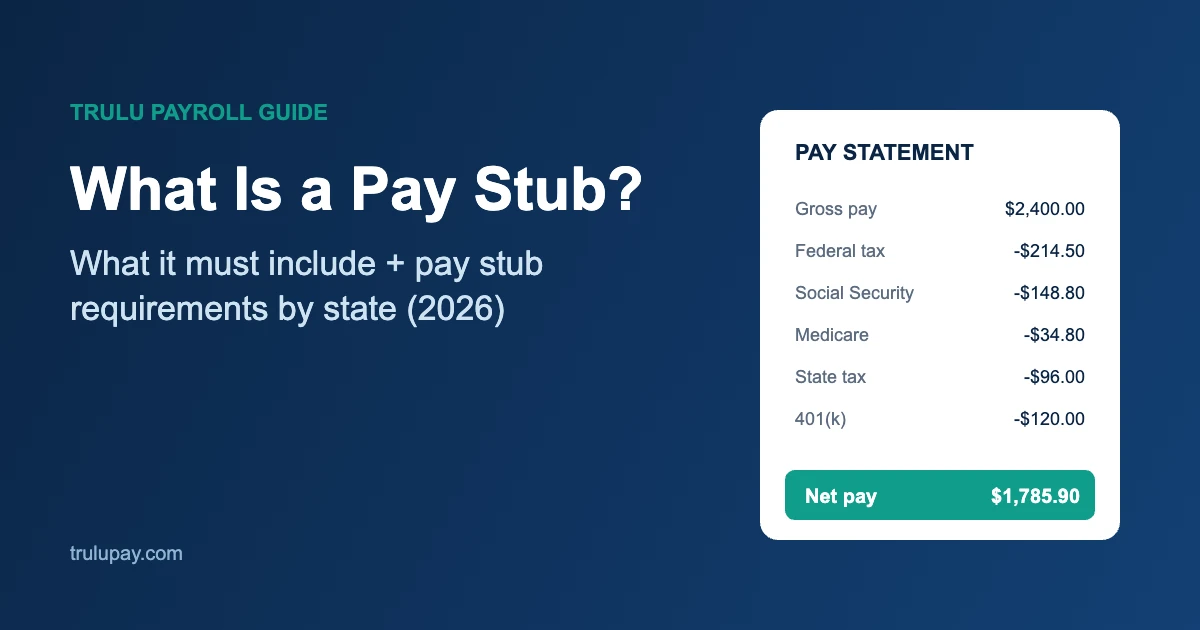
Accurate overtime also has to show up clearly on every paycheck. Our breakdown of what a pay stub must include explains how overtime hours and rates should appear by state.
Calculate overtime automatically with Trulu

Knowing how to calculate overtime pay by hand is valuable, but you shouldn’t have to redo the math every payday. Trulu connects attendance and payroll, so kiosk clock-ins and timesheets flow straight into the next pay run. Overtime hours, blended regular rates and pay stubs are handled for you, and Ollie, Trulu’s AI helper, flags approaching overtime before the week ends so managers can adjust schedules.
If you’re new to payroll, start with our step-by-step guide to running payroll, or compare tools in our HR and payroll software buyer’s guide.
Frequently asked questions
How do you calculate overtime pay for hourly employees?
Multiply the hourly rate by 1.5 to get the overtime rate, then multiply that by the number of hours worked over 40 in the workweek. Add it to regular pay for the first 40 hours. At $18 per hour and 44 hours, that’s $720 + (4 × $27) = $828.
How do you calculate overtime pay for salaried employees?
If the employee is non-exempt, divide the weekly salary by the hours it’s meant to cover to get the regular rate, then pay 1.5× that rate for hours over 40. Exempt salaried employees who meet the salary and duties tests aren’t owed overtime.
Is overtime calculated weekly or per pay period?
Weekly. Under federal law, overtime is based on each fixed 7-day workweek, even if you pay biweekly or semimonthly. Some states also require daily overtime.
Do paid holidays and PTO count toward overtime?
Not under federal law. Only hours actually worked count toward the 40-hour threshold. You can choose to count them by policy, and union agreements sometimes require it.
What is double time and when is it required?
Double time is 2× the regular rate. Federal law never requires it. California requires double time for hours over 12 in a workday and over 8 on the seventh consecutive workday.
Is overtime pay taxed differently?
No. Overtime is regular wages for withholding, Social Security and Medicare. From 2025 through 2028, employees may deduct qualified overtime (the FLSA premium portion) on their federal income tax return, and employers report it on the W-2 with Box 12 code TT for 2026.
This article is for general information and isn’t legal or tax advice. Overtime rules vary by state and industry, so check with your state labor department or an employment attorney about your specific situation.