Every time you run payroll, you’re doing two jobs at once. You’re paying your people, and you’re collecting taxes on behalf of the federal government, your state, and sometimes your city. Get the first part wrong and an employee notices on Friday. Get the second part wrong and the IRS notices months later, usually with penalties and interest attached.
This guide breaks down payroll taxes for small business owners in plain English: what you withhold, what you pay out of pocket, the 2026 rates and wage limits, how to calculate a real paycheck, when to deposit, which forms to file, and the mistakes that cost small employers the most. We’ve also included what changes for 2027, so you can plan ahead.
Key takeaways
- Employers pay 7.65% in FICA on top of wages (6.2% Social Security + 1.45% Medicare) and withhold the same 7.65% from each employee.
- The 2026 Social Security wage base is $184,500. It rises to $192,300 in 2027.
- Unemployment taxes (FUTA and SUTA) are paid by the employer only, never withheld from employee pay (with a few state exceptions).
- Your deposit schedule (monthly or semiweekly) depends on your lookback period, not on how often you pay employees.
- Withheld taxes are “trust fund” money. If they aren’t paid, the IRS can hold business owners personally liable for 100% of the amount.
What are payroll taxes?
Payroll taxes are the taxes tied to wages you pay employees. They fall into two buckets:
- Taxes you withhold from employee paychecks. Federal income tax, the employee’s share of Social Security and Medicare, and state or local income tax where it applies. This money belongs to your employees and the government. You’re just holding it.
- Taxes you pay as the employer. Your matching share of Social Security and Medicare, federal unemployment tax (FUTA), and state unemployment tax (SUTA). These are a cost of having employees, on top of their gross pay.
A simple rule of thumb: budget roughly 8% to 11% above gross wages for employer payroll taxes, depending on your state’s unemployment rate and how many employees are still under the FUTA wage cap. Benefits and workers’ comp are separate costs on top of that.
Employer vs. employee payroll taxes: who pays what
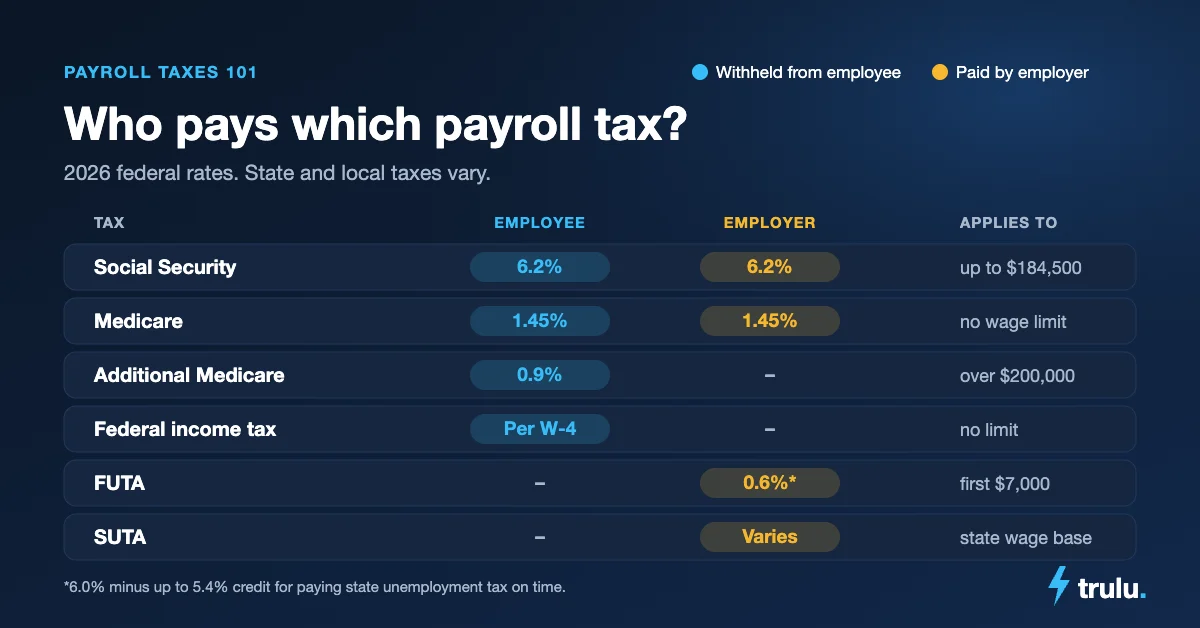
Here’s the full split for 2026. If you remember one table from this guide, make it this one.
| Tax | Employee pays (withheld) | Employer pays | 2026 wage limit |
|---|---|---|---|
| Social Security (OASDI) | 6.2% | 6.2% | First $184,500 |
| Medicare | 1.45% | 1.45% | No limit |
| Additional Medicare | 0.9% on wages over $200,000 | None (no employer match) | Applies above $200,000 |
| Federal income tax | Based on Form W-4 | None | No limit |
| FUTA (federal unemployment) | None | 6.0% (usually 0.6% after state credit) | First $7,000 |
| SUTA (state unemployment) | None in most states | Varies by state and employer | Varies by state |
| State/local income tax | Varies by state | None | Varies |
The federal payroll taxes, explained
FICA: Social Security and Medicare
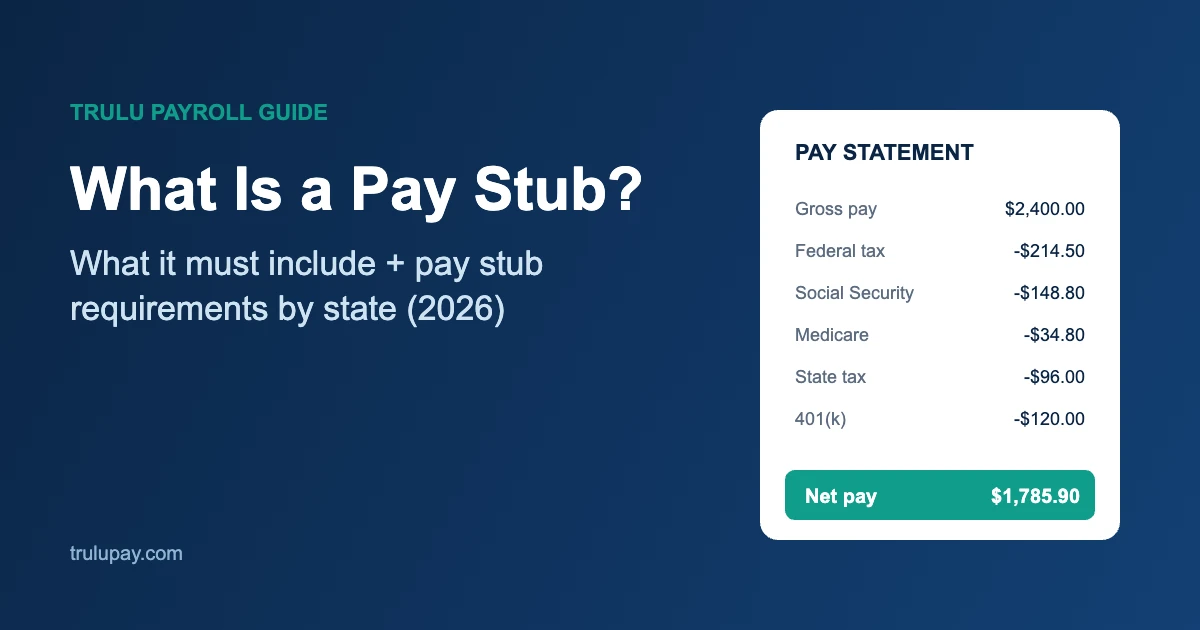
FICA (the Federal Insurance Contributions Act) is the biggest payroll tax for most small businesses. The combined rate is 15.3%, split evenly: you withhold 7.65% from the employee and pay a matching 7.65% yourself.
- Social Security: 6.2% each, but only on the first $184,500 an employee earns in 2026. Once someone crosses that line, both you and the employee stop paying Social Security tax for the rest of the year. The maximum is $11,439 per side.
- Medicare: 1.45% each, on every dollar. There’s no cap.
- Additional Medicare Tax: once an employee’s wages from you pass $200,000 in a calendar year, you must start withholding an extra 0.9% from their pay. You don’t match this one.
Federal income tax withholding
There’s no flat rate here. You calculate federal income tax withholding from each employee’s Form W-4, their pay frequency, and the IRS tables in Publication 15-T. Collect a W-4 before the first paycheck. If an employee doesn’t give you one, the IRS requires you to withhold as if they’re single with no adjustments.
FUTA: federal unemployment tax
FUTA funds federal unemployment programs and is paid only by the employer. The rate is 6.0% on the first $7,000 of each employee’s wages. If you pay your state unemployment taxes in full and on time, you get a credit of up to 5.4%, which brings the effective rate down to 0.6%, or a maximum of $42 per employee per year.
One catch: if your state has borrowed from the federal government to pay unemployment benefits and hasn’t repaid the loan, your credit shrinks. These are called “credit reduction states.” For 2025, California and the U.S. Virgin Islands were on the list, which raised FUTA costs for employers there on the 2025 Form 940.
State and local payroll taxes
State rules are where small businesses most often get tripped up, because every state is different. Plan for these:
- State unemployment insurance (SUTA). Every state has one. New employers usually get a standard starting rate, and it adjusts over time based on your claims history. Each state sets its own taxable wage base, which can be far higher than FUTA’s $7,000.
- State income tax withholding. Most states require it. A handful, including Texas, Florida, Nevada, South Dakota, Tennessee, Wyoming, and Alaska, don’t tax wages.
- Local taxes. Some cities, counties, and school districts levy their own wage taxes. Pennsylvania, Ohio, and New York City are common examples.
- Paid family and medical leave or disability programs. States such as California, New York, New Jersey, Washington, Massachusetts, and others fund these through payroll contributions, often withheld from employees.
Register with your state’s revenue department and its workforce or unemployment agency before your first payroll. You’ll need both account numbers to file and pay.
How to calculate payroll taxes: a worked example
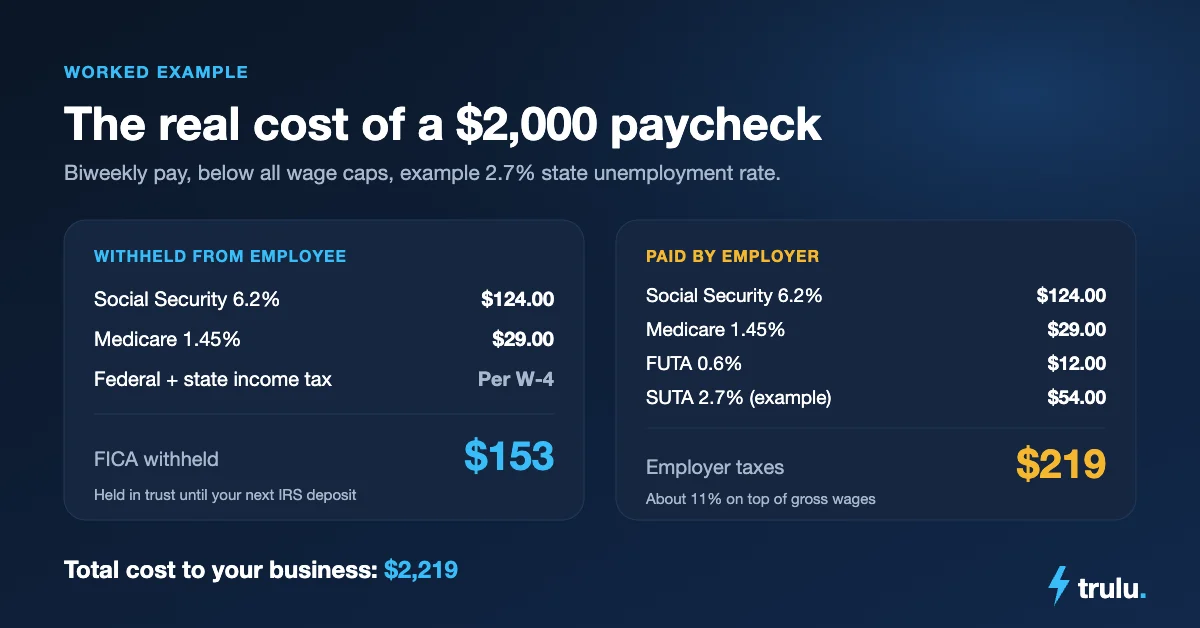
Let’s run the numbers on one biweekly paycheck. Say your employee earns $2,000 gross for the pay period, hasn’t hit any wage caps yet, and your state unemployment rate is 2.7% (a common new-employer rate; yours may differ).
| Line item | Rate | Withheld from employee | Paid by employer |
|---|---|---|---|
| Social Security | 6.2% | $124.00 | $124.00 |
| Medicare | 1.45% | $29.00 | $29.00 |
| Federal income tax | Per W-4 | Varies | – |
| FUTA | 0.6% | – | $12.00 |
| SUTA (example) | 2.7% | – | $54.00 |
| Total | $153.00 + income tax | $219.00 |
So this paycheck actually costs your business $2,219 in wages and payroll taxes, about 11% more than the gross amount. Meanwhile, you’re holding $153 plus the employee’s income tax withholding in trust until your next deposit.
Two things change the math as the year goes on. FUTA stops once an employee earns $7,000, so that line disappears after the first few months. And for higher earners, Social Security stops at $184,500 while Additional Medicare kicks in at $200,000. Payroll software tracks these thresholds per employee automatically. In a spreadsheet, they’re easy to miss.
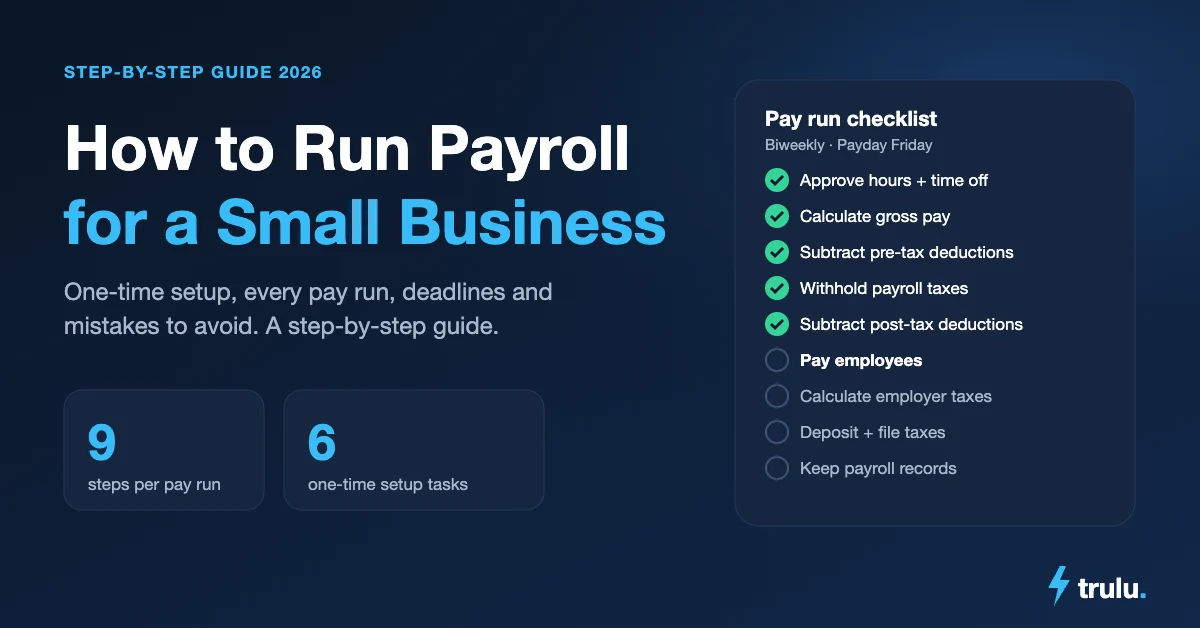
New to running payroll? Our step-by-step guide to running payroll for a small business walks through the full process, from collecting W-4s to issuing paychecks.
When to deposit payroll taxes: monthly vs. semiweekly
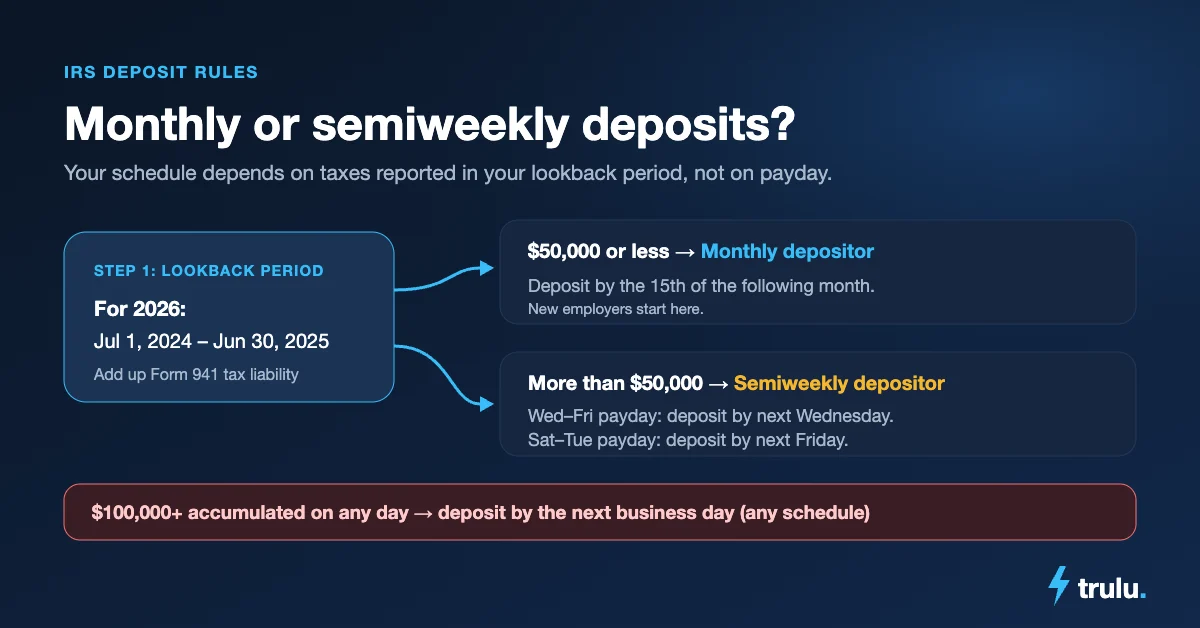
Withholding the money is only half the job. You also have to deposit it with the IRS on a set schedule, electronically, through EFTPS or another IRS-approved method. Your schedule is based on your lookback period: the 12 months from July 1 two years ago through June 30 of last year. For 2026, that’s July 1, 2024 to June 30, 2025.
- $50,000 or less in federal employment taxes during the lookback period: you’re a monthly depositor. Deposit each month’s taxes by the 15th of the following month.
- More than $50,000: you’re a semiweekly depositor. For paydays on Wednesday, Thursday, or Friday, deposit by the following Wednesday. For paydays on Saturday through Tuesday, deposit by the following Friday.
- $100,000 or more accumulated on any day: deposit by the next business day, no matter which schedule you’re on. If you’re a monthly depositor, you become a semiweekly depositor from that point on.
- Brand-new employers have no lookback history, so you start as a monthly depositor.
Note that how often you pay employees (weekly, biweekly, semimonthly) has nothing to do with how often you deposit taxes. A monthly depositor who runs biweekly payroll still deposits once a month. FUTA has its own rule: deposit quarterly once your undeposited FUTA liability tops $500.
Payroll tax forms and filing deadlines
Depositing taxes and reporting them are separate steps. These are the federal forms every small employer should know:
| Form | What it reports | When it’s due |
|---|---|---|
| Form 941 | Quarterly federal income tax withheld, plus Social Security and Medicare | Last day of the month after each quarter: April 30, July 31, October 31, January 31 |
| Form 944 | Annual version of Form 941, only if the IRS notifies you that you qualify (generally $1,000 or less in annual liability) | January 31 |
| Form 940 | Annual FUTA tax | January 31 |
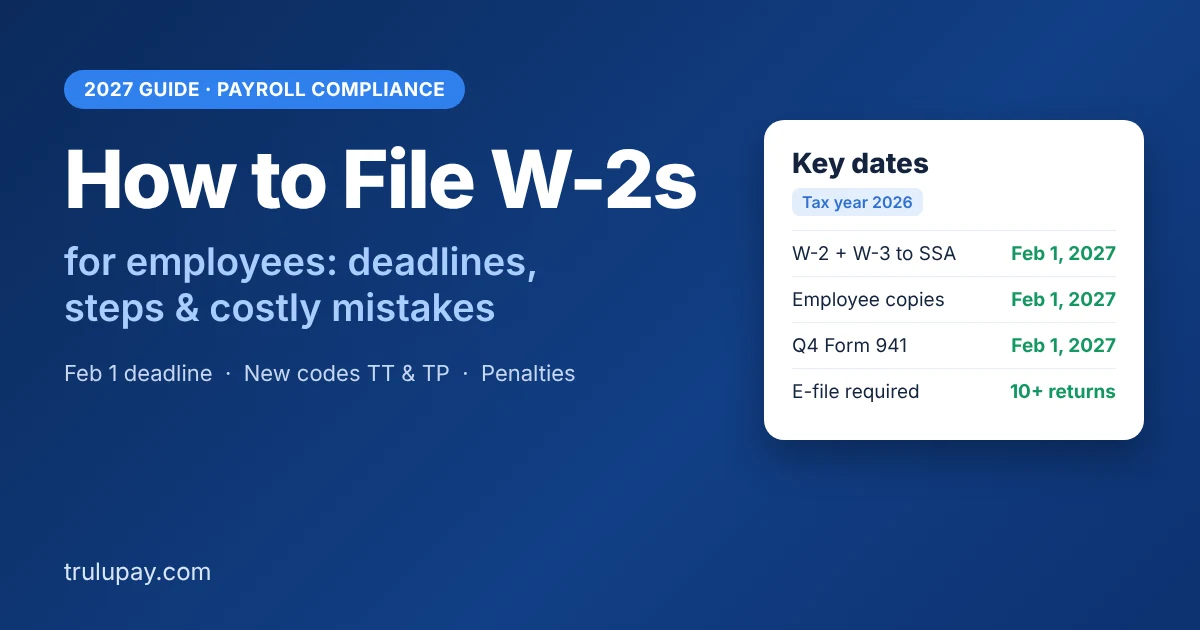
| Form W-2 and W-3 | Each employee’s annual wages and withholding, sent to employees and the Social Security Administration | January 31 |
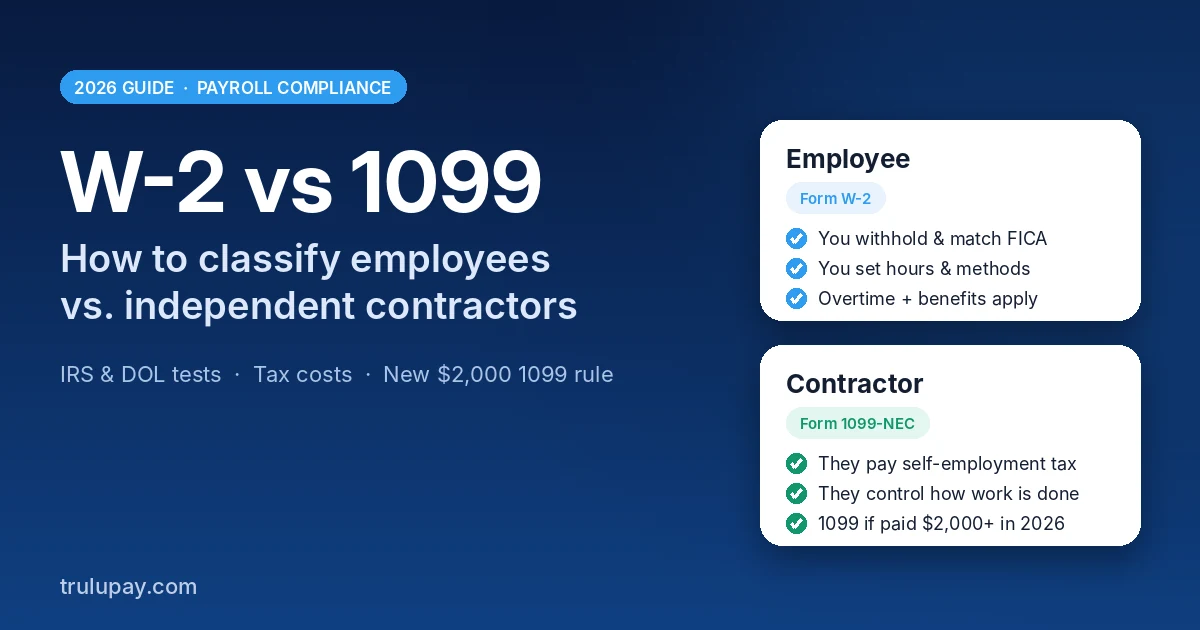
| Form 1099-NEC | Payments of $600 or more to independent contractors (for 2026 payments, the threshold rises to $2,000) | January 31 |
| State forms | State withholding and unemployment wage reports | Usually quarterly; varies by state |
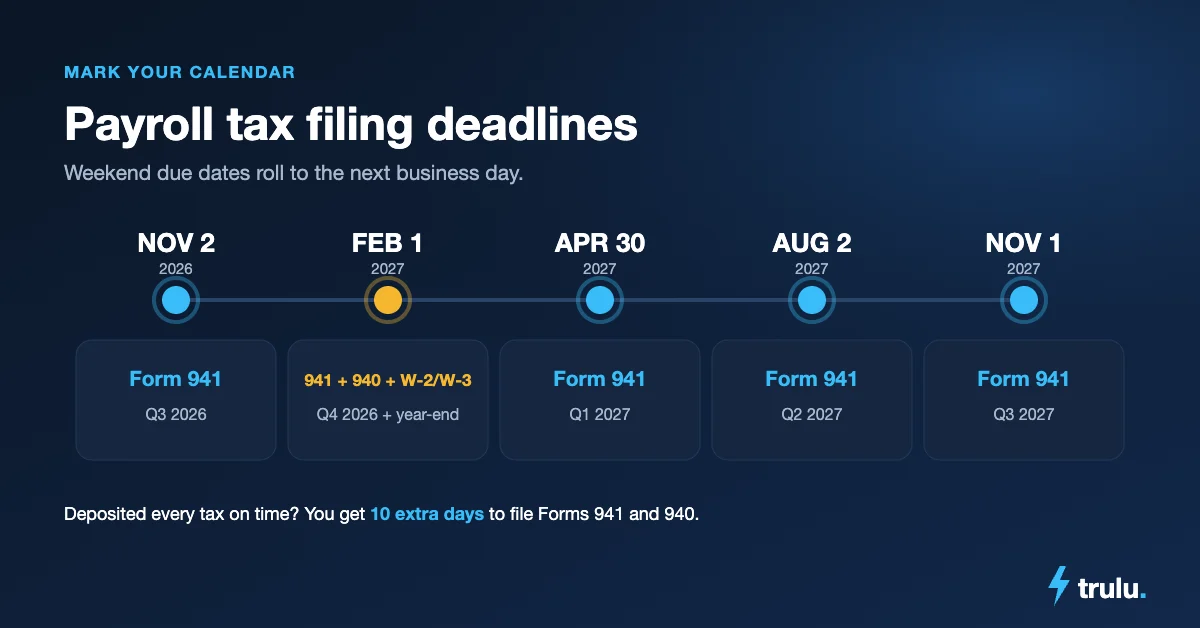
Coming up: the Form 941 for Q3 2026 is due Monday, November 2, 2026, because October 31 falls on a Saturday. For the same reason, your Q4 2026 Form 941, Form 940, and W-2s are all due Monday, February 1, 2027. If you made every deposit on time and in full, the IRS gives you an extra 10 days to file Forms 941 and 940.
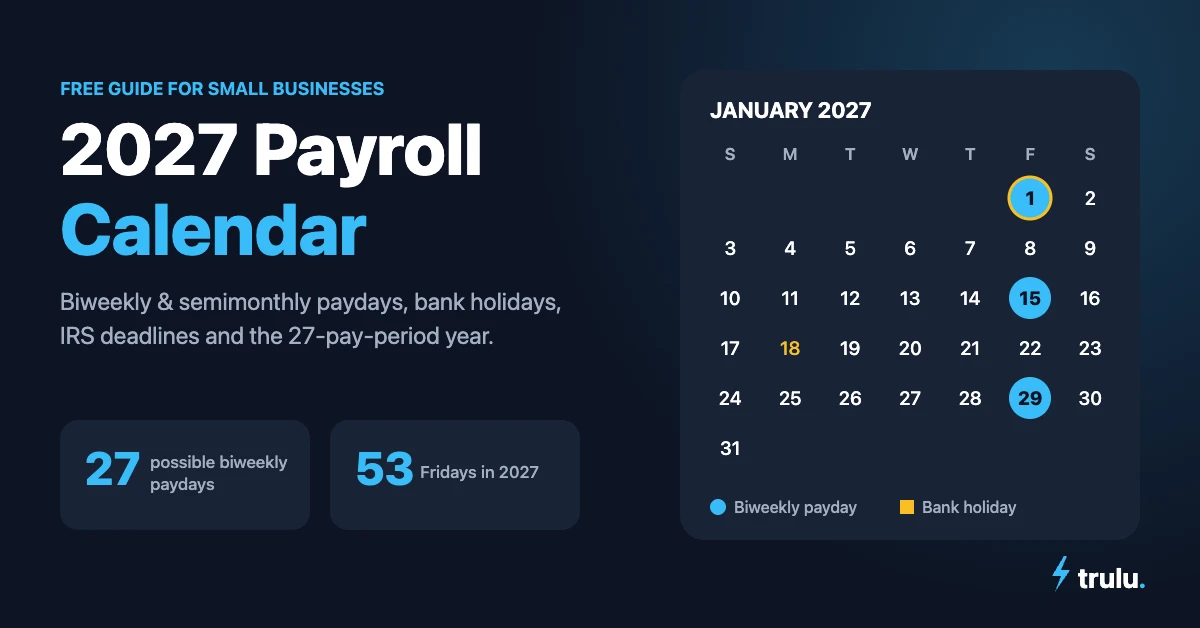
Want every deadline, payday, and bank holiday in one place? Download our 2027 payroll calendar.
What’s new for 2026 and 2027
- Higher Social Security wage base. $184,500 in 2026, rising to $192,300 in 2027, as announced by the Social Security Administration in October 2026. The maximum Social Security tax per side goes from $11,439 to $11,922.60.
- New W-2 reporting for overtime and tips. Starting with 2026 wages, employers report qualified overtime in Box 12 with code TT and qualified tips with code TP. These are reporting changes. You still withhold income tax and FICA on overtime and tips as usual. The employee claims any deduction on their own tax return.
- Updated Form W-4. The 2026 W-4 includes a worksheet for employees who expect qualified overtime or tips. Make sure new hires get the current version.
- Higher 1099 threshold. The reporting threshold for Form 1099-NEC rises from $600 to $2,000 for payments made in 2026.
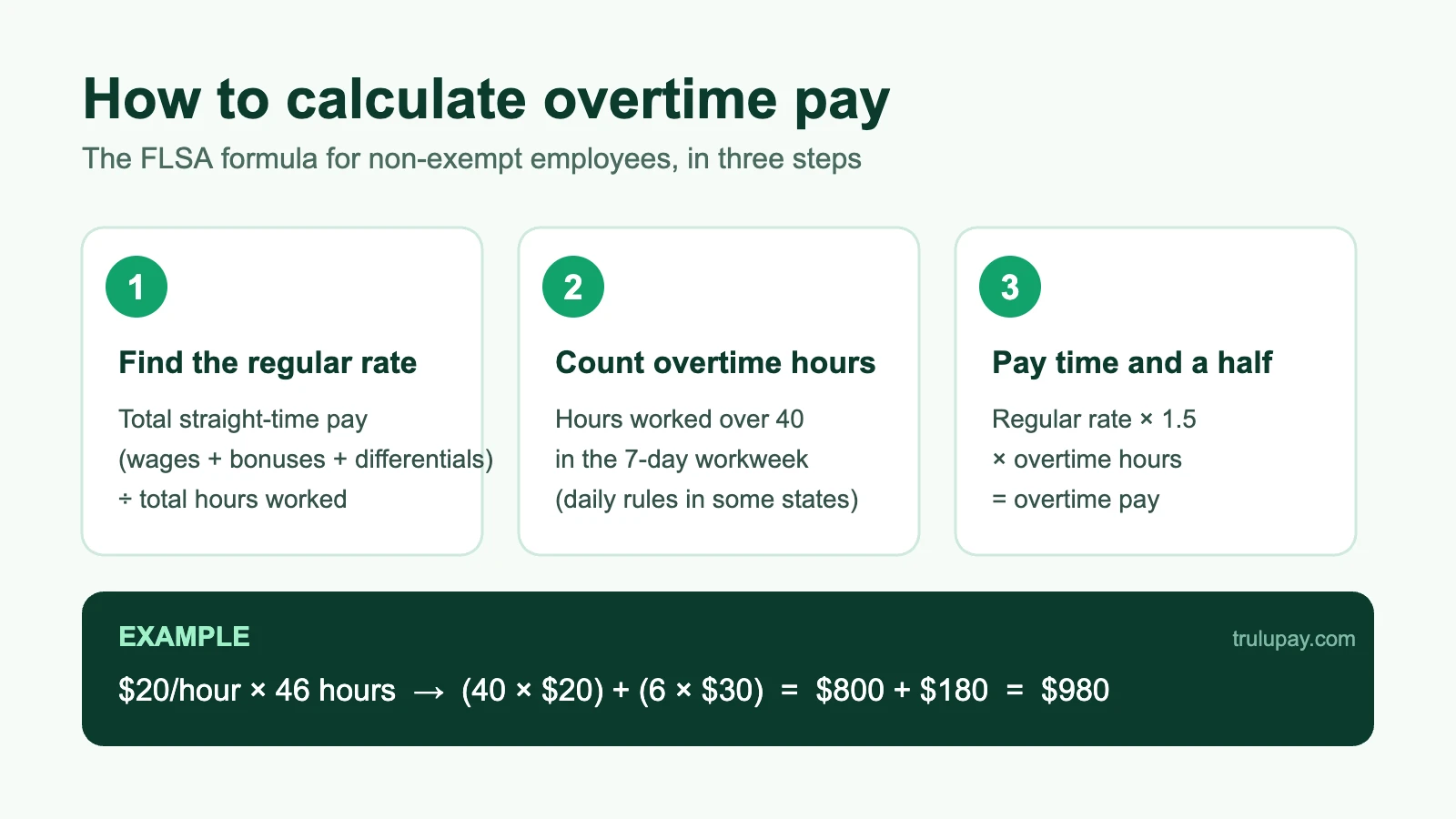
If you have hourly staff who work overtime, check now that your payroll setup separates FLSA overtime from other overtime premiums. Retrofitting that data in January is painful.
Employees vs. independent contractors
Payroll taxes apply to employees (W-2 workers). You don’t withhold or pay payroll taxes for genuine independent contractors (1099 workers). They pay self-employment tax themselves.
The key word is genuine. The IRS looks at behavioral control, financial control, and the relationship between you and the worker, not at what your contract calls them. If you set their hours, train them, provide their tools, and they work only for you, they’re likely an employee. Misclassifying workers can trigger back taxes for every unpaid FICA and unemployment dollar, plus penalties and interest. When in doubt, review the IRS guidance on worker classification.
Payroll tax penalties: what late or missed payments cost
The IRS treats payroll taxes more seriously than almost any other tax, because withheld amounts are your employees’ money. The failure-to-deposit penalty scales with how late you are:
| How late the deposit is | Penalty on the unpaid deposit |
|---|---|
| 1 to 5 calendar days | 2% |
| 6 to 15 calendar days | 5% |
| 16 or more days (or paid within 10 days of the first IRS notice) | 10% |
| More than 10 days after the first IRS notice, or on demand | 15% |
That’s before separate penalties for filing late, paying late, and interest. The most serious is the Trust Fund Recovery Penalty: if withheld income tax and employee FICA aren’t paid, the IRS can collect 100% of that amount personally from owners, officers, or anyone responsible for paying it. An LLC or corporation does not shield you here.
7 common payroll tax mistakes small businesses make
- Using payroll tax money for cash flow. “Borrowing” withheld taxes to cover rent is the fastest route to the Trust Fund Recovery Penalty. Keep payroll taxes in a separate account if that helps.
- Running payroll before registering with the state. You need state withholding and unemployment accounts first.
- Using the wrong deposit schedule. Recheck your lookback period every year. Growth can quietly move you from monthly to semiweekly.
- Missing wage base changes. Continuing Social Security withholding past $184,500, or forgetting to start Additional Medicare at $200,000.
- Misclassifying employees as contractors to avoid payroll taxes.
- Forgetting taxable fringe benefits. Gift cards, bonuses, and personal use of a company car are generally taxable wages.
- Losing track of deadlines across agencies. Federal, state, and local due dates rarely line up, and weekend shifts change them every year.
How payroll software makes payroll taxes easier
You can handle payroll taxes by hand with IRS tables, a spreadsheet, and calendar reminders. Many owners do at first. But every new hire, state, and wage threshold adds another place for an error to hide. Good payroll software calculates withholding from each W-4, tracks wage bases per employee, keeps your deposit and filing deadlines in front of you, and stores the records you’ll need at year-end.
If you’re comparing options, our buyer’s guide to HR and payroll software for small business covers the features worth paying for and the questions to ask before you switch.
Trulu brings payroll, time off, onboarding, attendance, and performance together in one simple dashboard, so payday, payroll deadlines, and your team’s hours live in the same place instead of five different tools. We’re opening soon. Join the Trulu waitlist to get your first 4 months free, with no setup fee and no credit card required.
Payroll taxes FAQ
How much are payroll taxes for a small business?
Employers pay 7.65% of wages for Social Security and Medicare, plus federal unemployment tax (usually 0.6% on the first $7,000 per employee) and state unemployment tax, which varies by state. Most small businesses should budget about 8% to 11% on top of gross wages.
What payroll taxes does the employer pay vs. the employee?
Both pay 6.2% Social Security (up to $184,500 in 2026) and 1.45% Medicare. Employees also have federal, and usually state, income tax withheld, plus 0.9% Additional Medicare above $200,000. Employers alone pay FUTA and, in most states, SUTA.
How often do I need to pay payroll taxes?
Most new and small employers deposit monthly, by the 15th of the following month. If you reported more than $50,000 in employment taxes during your lookback period, you deposit semiweekly. Quarterly Form 941 reports are due April 30, July 31, October 31, and January 31.
What happens if I pay payroll taxes late?
The IRS charges a failure-to-deposit penalty of 2% to 15% depending on how late the deposit is, plus interest. Unpaid withheld taxes can also lead to the Trust Fund Recovery Penalty, which makes responsible individuals personally liable for 100% of the unpaid amount.
Do I pay payroll taxes for independent contractors?
No. You don’t withhold or pay payroll taxes for properly classified independent contractors. You generally do need to file Form 1099-NEC for contractors you pay above the reporting threshold.
What is the Social Security wage base for 2027?
The Social Security wage base is $192,300 for 2027, up from $184,500 in 2026. Wages above that amount aren’t subject to the 6.2% Social Security tax for the year. Medicare tax still applies to all wages.
This article is for general information only and isn’t tax or legal advice. Payroll tax rules vary by state and change often. Confirm details with the IRS Employer’s Tax Guide (Publication 15), the Social Security Administration, your state agencies, or a qualified tax professional.