A W-2 employee works under your control: you withhold income tax, pay half of their Social Security and Medicare, and owe minimum wage and overtime. A 1099 contractor runs their own business, controls how the work gets done and pays their own self-employment tax. What decides it is how the relationship actually works, not what the contract says.
Every time you bring someone on to help your business, you make a decision that affects your taxes, your paperwork and your legal risk: is this person a W-2 employee or a 1099 independent contractor? Get it right and payroll runs smoothly. Get it wrong and you can owe years of back taxes, penalties and unpaid overtime.
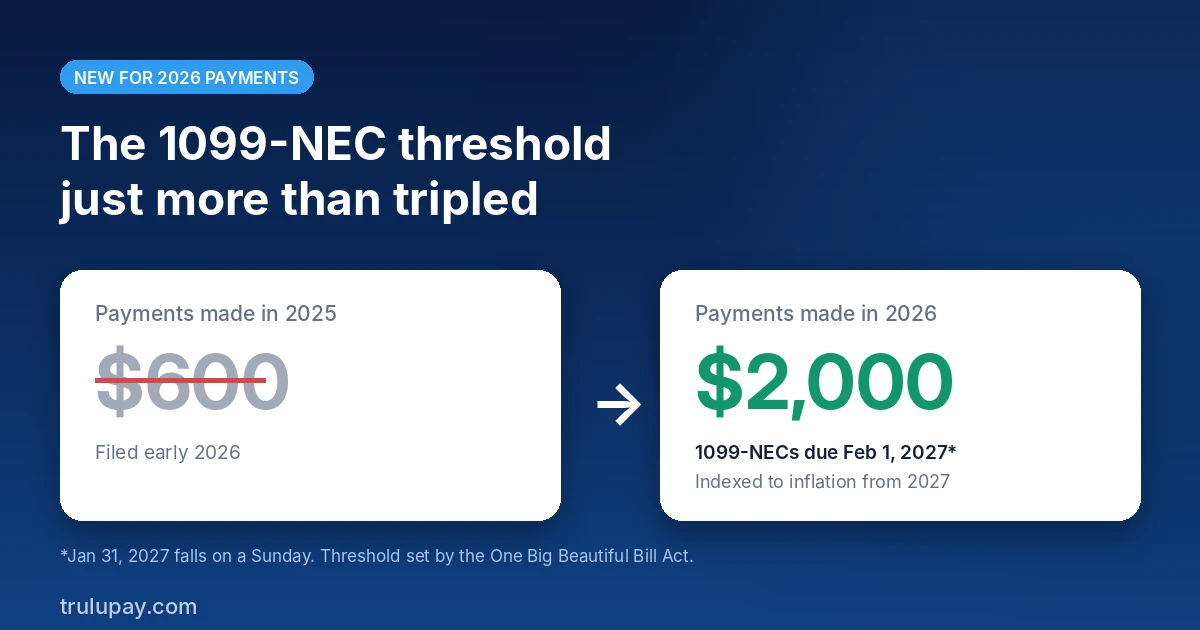
The stakes are higher heading into 2027. For 2026 payments, the 1099-NEC reporting threshold has jumped from $600 to $2,000, the threshold starts adjusting for inflation in 2027, and the Department of Labor (DOL) is replacing its independent contractor rule. This guide explains the difference between W-2 and 1099 workers, the tests the IRS and DOL use, what each option really costs, and how to fix a classification mistake before it becomes expensive.
Key takeaways
- A W-2 employee works under your direction. You withhold income tax, pay half of their FICA and owe minimum wage and overtime.
- A 1099 contractor runs their own business, controls how the work gets done and pays their own self-employment tax.
- The label in a contract does not decide classification. How the relationship actually works does.
- For payments made in 2026, you file Form 1099-NEC only for contractors you paid $2,000 or more (up from $600).
- Misclassification can trigger back taxes, IRS penalties, unpaid overtime and state fines, but the IRS offers ways to correct it.
What is the difference between a W-2 employee and a 1099 contractor?
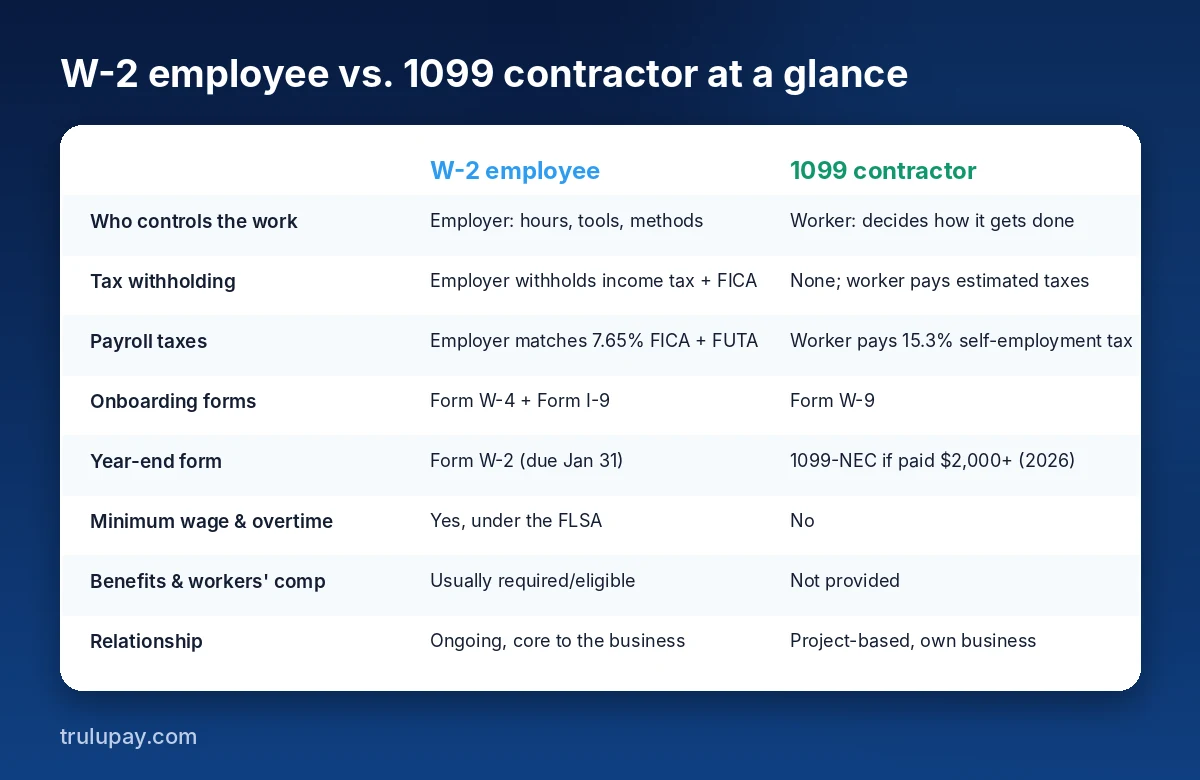
The names come from the tax forms you file at year-end. A W-2 employee receives Form W-2, which reports their wages and the taxes you withheld from every paycheck. A 1099 contractor receives Form 1099-NEC, which reports what you paid them, with no taxes withheld.
The deeper difference is control and independence. An employee works within your business: you decide when, where and how they work. A contractor works for their own business: you agree on a result, and they decide how to deliver it.
What a W-2 employee looks like
- Works a schedule you set, often with ongoing, open-ended employment
- Uses your tools, systems and equipment, and follows your training and processes
- Is paid hourly or salaried through your regular payroll
- Is protected by minimum wage, overtime, unemployment insurance and workers’ compensation laws
What a 1099 contractor looks like
- Is hired for a defined project or deliverable, and often serves other clients
- Sets their own hours and methods, and supplies their own tools
- Sends invoices and can make or lose money based on how they run their business
- Pays their own income tax and self-employment tax through quarterly estimated payments
How to classify workers: the IRS and DOL tests
There is no single test. The IRS, the DOL and your state each apply their own rules, and a worker can count as an employee under one test even if they pass another. You should meet the strictest test that applies to you. For the IRS’s own worked examples, see IRS Publication 15-A.
1. The IRS common-law test (federal taxes)
For tax purposes, the IRS looks at the whole relationship and groups the evidence into three categories:
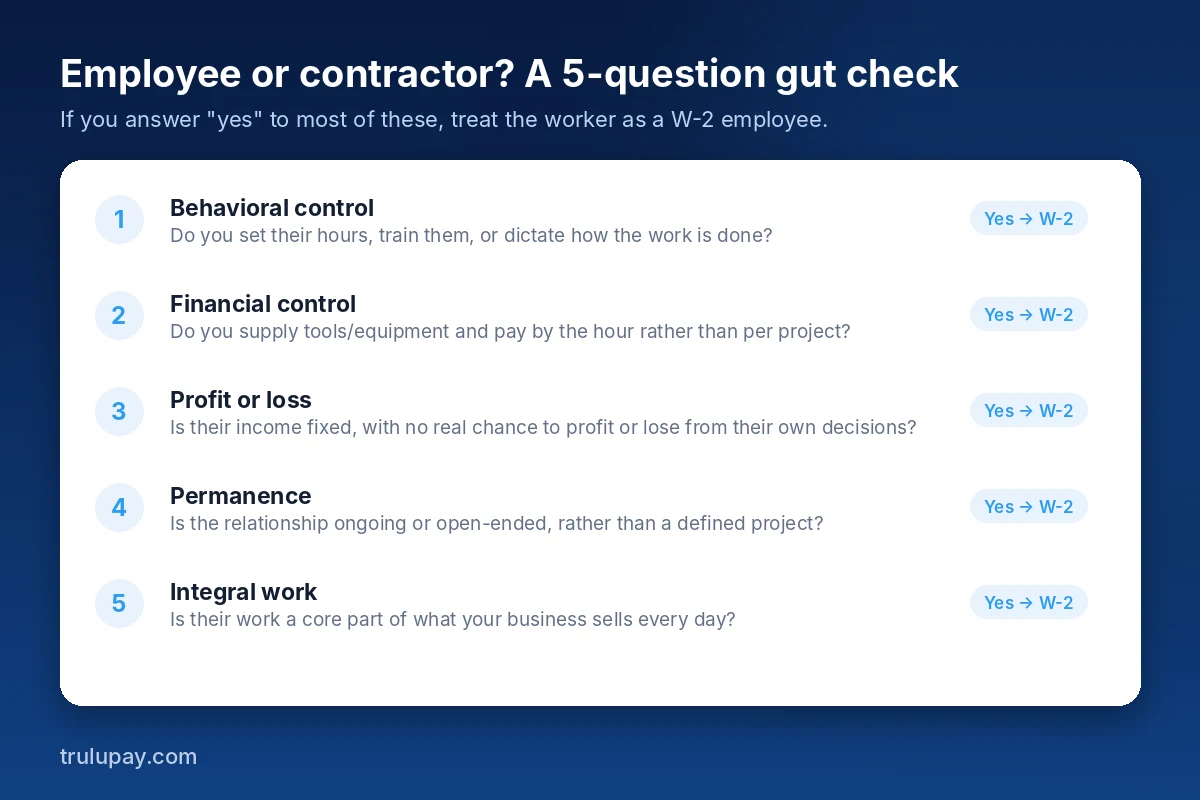
- Behavioral control: Do you control or have the right to control what the worker does and how they do it, through instructions, training or evaluations?
- Financial control: Do you control the business side of the job, such as how they are paid, whether expenses are reimbursed and who provides tools and supplies?
- Type of relationship: Is there a written contract, are benefits provided, is the work expected to continue and is it a key part of your business?
2. The DOL economic reality test (wage and hour law)
For minimum wage and overtime under the Fair Labor Standards Act (FLSA), the DOL asks whether the worker is economically dependent on you or truly in business for themselves. In February 2026 the DOL proposed a new rule to replace the 2024 standard. It gives the most weight to two core factors:
- Control over the work: Who sets schedules, chooses assignments and decides how the work is done?
- Opportunity for profit or loss: Can the worker earn more or lose money through their own initiative, investment or management?
Other factors include the skill the work requires, how permanent the relationship is and whether the work is part of an integrated unit of production. The proposal also stresses that what actually happens day to day matters more than what the contract says. Until a final rule takes effect, check the DOL’s site for the current standard before you make a decision. Courts also apply their own economic-reality test either way.
3. State tests, including the ABC test
Many states use stricter rules for wage laws, unemployment insurance or workers’ comp. California, Massachusetts and New Jersey are well known for the ABC test, which presumes a worker is an employee unless you can prove all three of the following:
- A: The worker is free from your control and direction in performing the work.
- B: The work is outside the usual course of your business.
- C: The worker is customarily engaged in an independently established trade or business.
Prong B trips up many small businesses. A salon that hires a stylist “as a contractor” will struggle to prove that styling hair is outside the usual course of a salon’s business.
W-2 vs 1099: what each really costs your business
Contractors often look cheaper because you skip employer payroll taxes and benefits. Here is what you take on with each type of worker:
| Cost or obligation | W-2 employee | 1099 contractor |
|---|---|---|
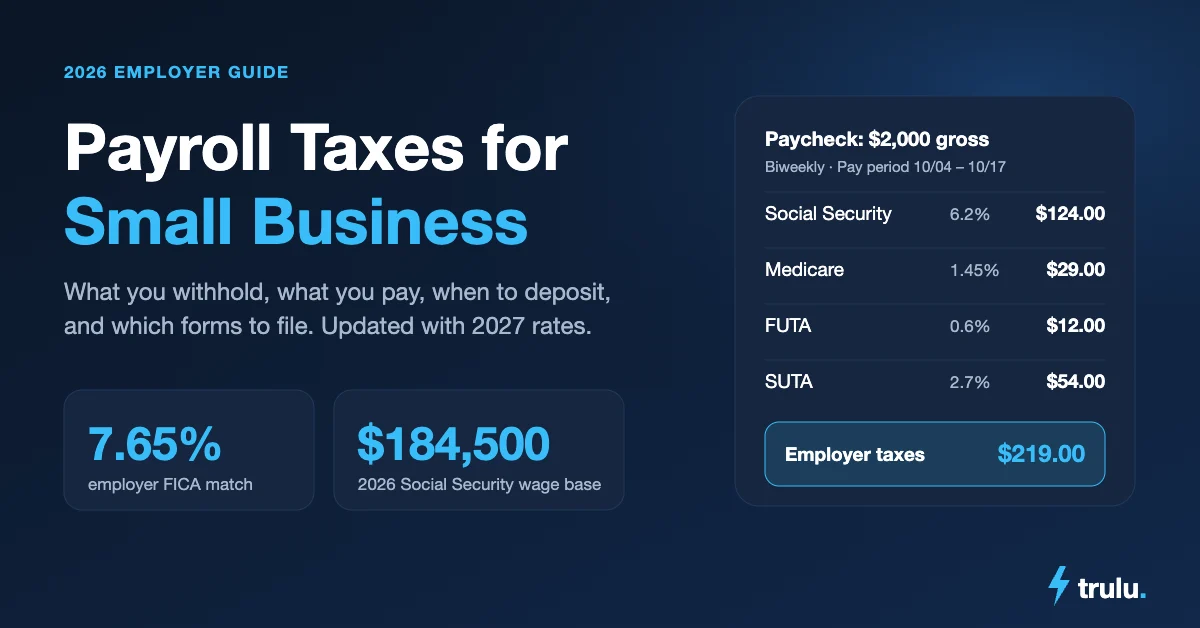
| Social Security and Medicare (FICA) | You withhold 7.65% and match another 7.65% (Social Security 6.2% applies to wages up to $184,500 in 2026 and $192,300 in 2027; Medicare 1.45% has no cap) | The contractor pays 15.3% self-employment tax on 92.35% of net earnings |
| Federal income tax withholding | Withheld from each paycheck based on Form W-4 | None; the contractor pays estimated taxes |
| Federal unemployment tax (FUTA) | Yes, on the first $7,000 of wages | No |
| State unemployment tax (SUTA) | Yes, at your state rate | No |
| Workers’ compensation | Required in most states | Usually not required |
| Minimum wage and overtime | Required for non-exempt employees | Not required |
| Benefits (health, 401(k), PTO) | Often offered; sometimes required | Not offered |
| Year-end form | Form W-2 | Form 1099-NEC (if paid $2,000+ in 2026; inflation-adjusted from 2027) |
Cost alone should never decide classification. A contractor who should have been an employee can end up costing far more than an employee would have, once back taxes and penalties are added.
1099-NEC threshold for 2026 and 2027: $600 to $2,000 and beyond
The One Big Beautiful Bill Act raised the reporting threshold for Forms 1099-NEC and 1099-MISC from $600 to $2,000 for payments made on or after January 1, 2026. The threshold will be adjusted for inflation starting in 2027, and the backup withholding threshold rises to match.
What this means in practice:
- Fewer forms: A contractor you paid $1,500 in 2026 no longer needs a 1099-NEC.
- Classification still matters: The threshold only changes reporting. A worker who should be an employee is still an employee, whatever you paid them.
- Keep collecting W-9s: Get a Form W-9 before the first payment, since you may not know in advance whether a contractor will reach $2,000.
- Check your state: Some states set their own reporting thresholds, so confirm your state’s rules before skipping a form.
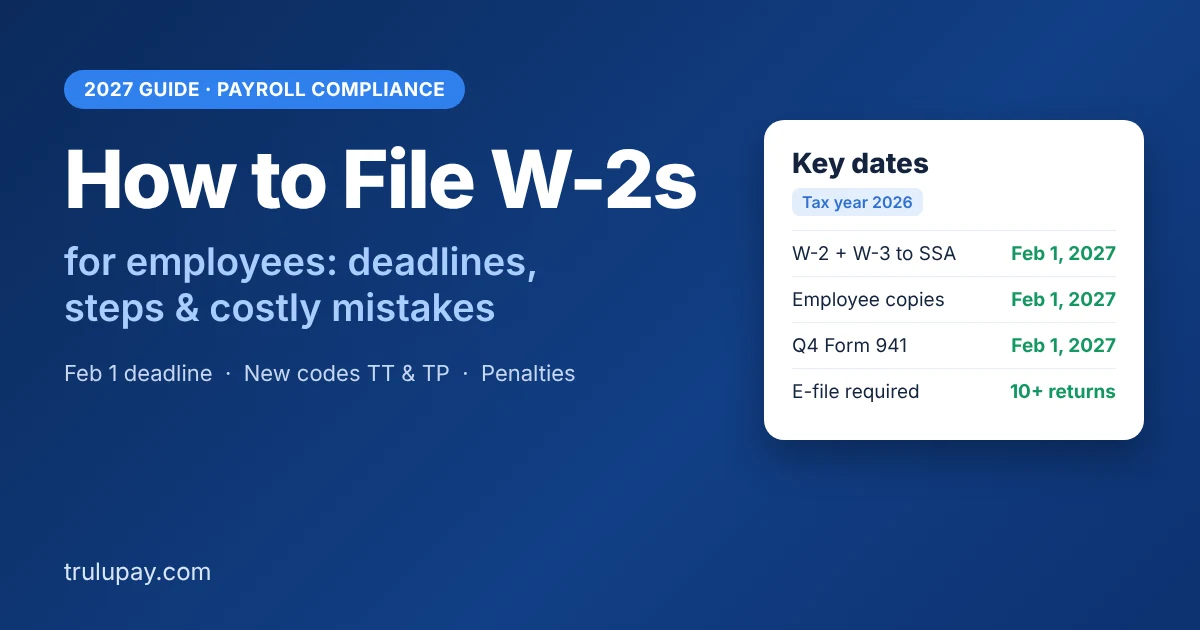
Add the February 1, 2027 deadline for W-2s and 1099-NECs to your 2027 payroll calendar now so year-end filing doesn’t sneak up on you.
What changes for employers in 2027
A few changes take effect for 2027 payroll and payments. Build them into your planning now:
- The 1099 threshold becomes inflation-adjusted. Starting with payments made in 2027, the $2,000 threshold for Forms 1099-NEC and 1099-MISC will be indexed for inflation. Watch the IRS 1099-NEC instructions for the official figure and keep collecting W-9s in the meantime.
- The Social Security wage base rises to $192,300. That is up from $184,500 in 2026, so the most you pay in employer Social Security tax per employee rises to $11,922.60. The 1.45% Medicare tax still has no cap.
- The DOL contractor rule is being finalized. The February 2026 proposal puts the most weight on control and on the worker’s opportunity for profit or loss. Re-check your contractor relationships once the final rule is published.
- The FUTA wage base stays at $7,000. State unemployment wage bases and rates change every year, so confirm your 2027 SUTA rate when your state sends it.
The cost of misclassifying employees as contractors
If the IRS, DOL or a state agency decides your contractor was really an employee, you may owe:
- Back employment taxes: The employer share of FICA, plus FUTA and state unemployment tax, often for several years, with interest.
- The employee’s share you didn’t withhold: When the mistake was unintentional, Section 3509 of the tax code generally sets this at 1.5% of wages for income tax and 20% of the employee’s FICA. Those rates double to 3% and 40% if you didn’t file 1099s. The reduced rates aren’t available for intentional disregard.
- Information return penalties: Penalties apply per form for missing or incorrect W-2s and 1099s.
- Unpaid wages and overtime: Under the FLSA, plus an equal amount in liquidated damages in many cases.
- State penalties and benefit claims: Fines, unpaid workers’ comp premiums and retroactive benefit eligibility.
How to fix a misclassification
If you realize a worker should have been on payroll, act before an audit or a complaint does it for you:
- Reclassify going forward. Collect a Form W-4 and Form I-9, add the worker to payroll and start withholding.
- Consider the IRS Voluntary Classification Settlement Program (VCSP). Eligible businesses that agree to treat workers as employees going forward pay roughly 10% of one year’s reduced employment tax liability, with no interest or penalties. Apply with Form 8952 through the IRS VCSP page.
- Ask the IRS if you’re unsure. Form SS-8 requests an official determination, but expect it to take several months.
- Talk to a professional. A CPA or employment attorney can assess back-pay exposure under federal and state law.
Best practices for managing W-2 and 1099 workers
- Decide classification before day one. Run the five questions above for every new role, not just new people.
- Use written agreements that match reality. A contractor agreement should define deliverables, not hours, and you should actually manage the relationship that way.
- Keep onboarding documents organized. Store W-4s, I-9s and W-9s in one place, with reminders for anything that expires.
- Review contractors once a year. A short project that turned into a full-time, open-ended role is the most common path to misclassification.
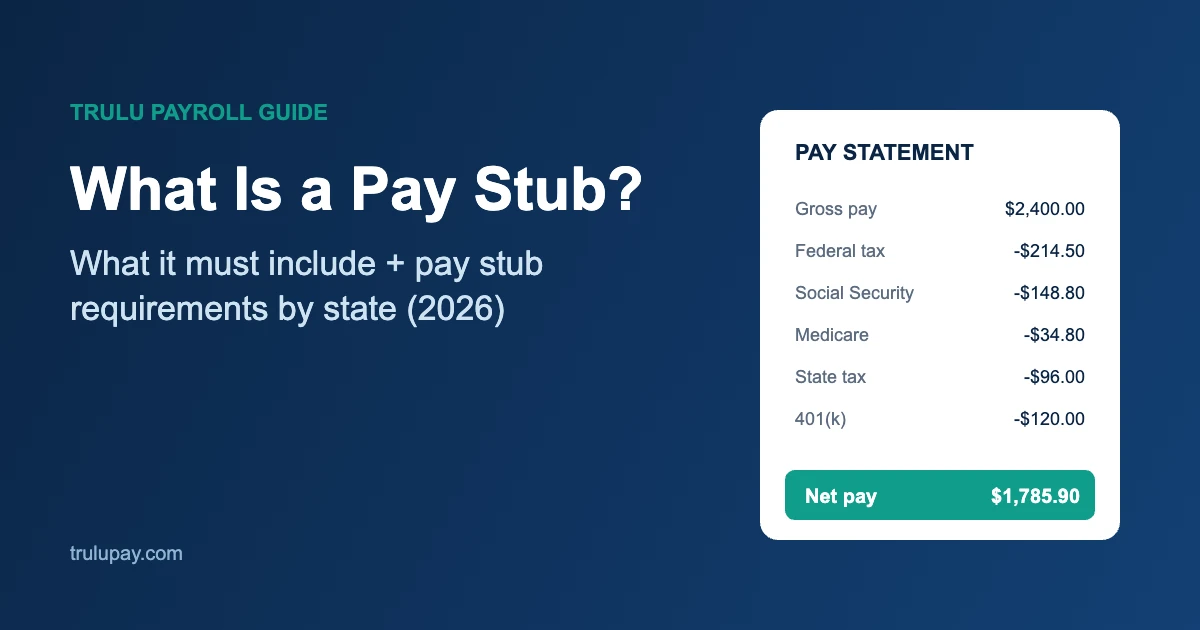
- Give every worker a clear record of pay. Employees should receive an accurate pay stub each pay period. Contractors should have invoices and payment records you can match to their 1099.
Manage employees and contractors in one place with Trulu
Mixed teams of hourly staff, salaried employees and contractors are where spreadsheets break down. Trulu brings payroll, HR and onboarding into one connected dashboard. Timesheets flow into pay runs, new-hire paperwork is stored with expiry alerts, and Ollie, Trulu’s AI helper, flags what needs your attention before payday.
Trulu is launching soon. Join the waitlist to get your first 4 months free, with no setup fee, no credit card required and your launch rate locked in for life.
Frequently asked questions
Can a worker be both a W-2 employee and a 1099 contractor for the same business?
Rarely. The IRS will look closely if someone does similar work under both arrangements. It is only defensible when the contract work is distinct from the person’s regular job and done independently. In most cases, pay the work through payroll.
Is it cheaper to hire a 1099 contractor than a W-2 employee?
Often, yes. You avoid the employer share of FICA, unemployment taxes, workers’ comp and benefits. But those savings only hold if the worker truly qualifies as a contractor. Misclassification costs can wipe them out many times over.
Do I need to send a 1099 to a contractor I paid less than $2,000?
For payments made in 2026, the federal 1099-NEC threshold is $2,000, so you generally don’t need to file one below that amount. Some states have lower thresholds, and the contractor still has to report all income they earned.
When are 2026 W-2s and 1099-NECs due?
Both are normally due January 31 to workers and to the IRS or SSA. Because January 31, 2027 falls on a Sunday, the deadline moves to Monday, February 1, 2027.
Does a signed contractor agreement protect me from misclassification?
No. A contract helps show intent, but the IRS, DOL and states look at how the work is actually performed. If you control the worker like an employee, they are likely an employee regardless of the paperwork.
W-2 vs 1099: which is better for the worker?
It depends on what the worker values. W-2 employees get taxes withheld, an employer share of FICA, overtime protection, unemployment insurance and often benefits. 1099 contractors get more control and can deduct business expenses, but they pay the full 15.3% self-employment tax and fund their own benefits. A contractor usually needs a higher rate to come out even.
What is the 1099 threshold for 2027?
For payments made in 2026 the federal 1099-NEC and 1099-MISC threshold is $2,000. Starting in 2027 that amount is adjusted for inflation, and the IRS will publish the exact figure. Until then, keep collecting a Form W-9 from every contractor before the first payment.
This article is for general information and isn’t tax or legal advice. Rules vary by state and change over time, so confirm details with a qualified professional for your situation.