If you run payroll for a small team, 2027 has a twist: the year starts on a Friday. That one detail gives some employers 27 biweekly paydays instead of the usual 26, and it moves several bank holidays around your pay runs. This 2027 payroll calendar lays out every payday, processing deadline, bank holiday and IRS due date you need, so you can plan the whole year in one sitting.
Below you’ll find ready-to-use biweekly, semimonthly and monthly payroll schedules for 2027, a clear answer to how many pay periods are in 2027, and a step-by-step plan for handling a 27th paycheck without blowing your budget.
Key takeaways: the 2027 payroll calendar at a glance
- 2027 has 53 Fridays. Weekly payrollers paying on Friday will run 53 payrolls instead of 52.
- Biweekly employers may have 27 pay periods. If your first Friday payday of 2027 is January 1, you have 27 paydays. If it is January 8, you have 26.
- January 1, 2027 is a bank holiday. A January 1 payday must be paid on Thursday, December 31, 2026, and that paycheck counts as 2026 wages.
- Semimonthly and monthly schedules don’t change: 24 and 12 paydays, respectively.
- Banks close on 9 weekdays in 2027. Juneteenth, Christmas and New Year’s Day 2028 fall on Saturdays, so the Federal Reserve stays open the Friday before.
How many pay periods are in 2027?
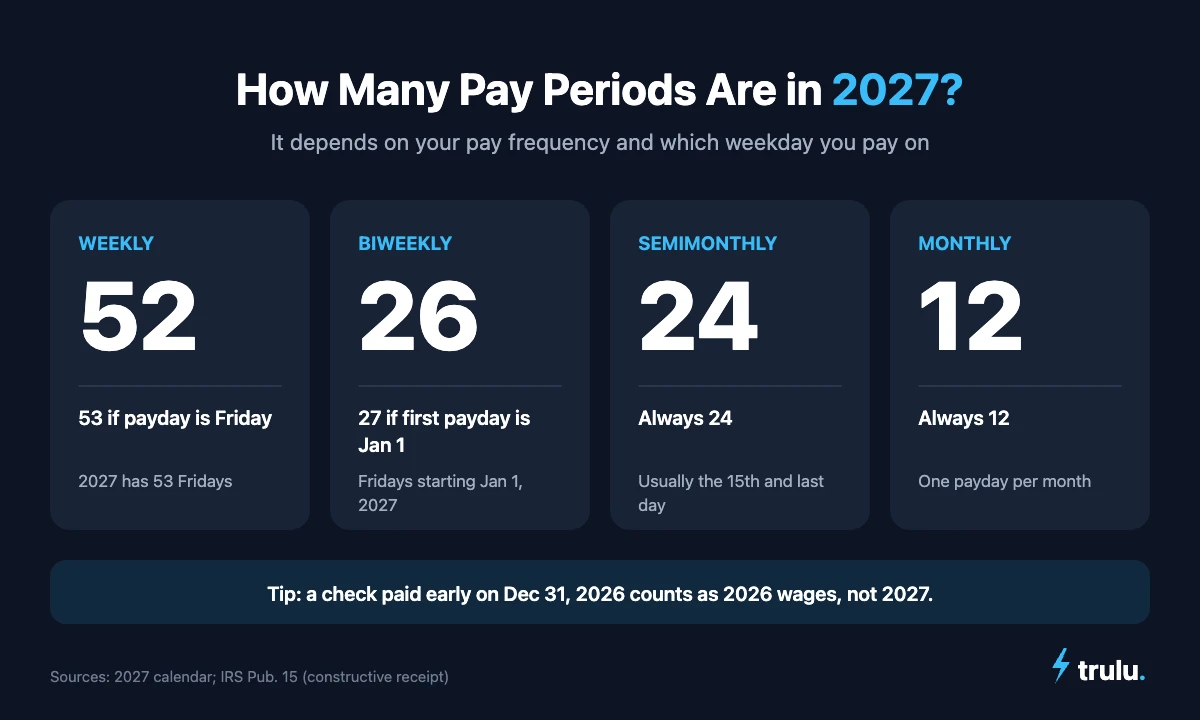
The number of pay periods in 2027 depends on how often you pay and which weekday is payday. Because 2027 has 365 days and starts on a Friday, Friday is the only weekday that appears 53 times.
| Pay frequency | Pay periods in 2027 | When the count changes |
|---|---|---|
| Weekly | 52 | 53 if payday is Friday |
| Biweekly (every other week) | 26 | 27 if your first Friday payday is Jan 1, 2027 |
| Semimonthly (twice a month) | 24 | Never changes |
| Monthly | 12 | Never changes |
A 27-pay-period year happens about once every 11 years for biweekly employers, which is why it often catches small businesses off guard. If you are new to running payroll, our step-by-step guide to running payroll for a small business covers the basics before you set your 2027 schedule.
2027 biweekly payroll calendar
Biweekly payroll is the most common pay schedule in the U.S., so this part of the 2027 payroll calendar matters most for small businesses. The two 2027 biweekly payroll calendars below assume a few standard settings, so adjust them to match your own setup:
- Each pay period runs Sunday through Saturday for two weeks.
- Payday is the Friday six days after the period ends.
- “Submit payroll by” is two banking days before payday, the typical cutoff for direct deposit. Check your provider’s exact deadline.
Schedule A: Friday paydays starting January 1, 2027 (27 paydays)
| # | Pay period (Sun–Sat) | Payday (Fri) | Submit payroll by |
|---|---|---|---|
| 1 | Dec 13–Dec 26, 2026 | Jan 1* | Dec 29, 2026 |
| 2 | Dec 27–Jan 9 | Jan 15 | Jan 13 |
| 3 | Jan 10–Jan 23 | Jan 29 | Jan 27 |
| 4 | Jan 24–Feb 6 | Feb 12 | Feb 10 |
| 5 | Feb 7–Feb 20 | Feb 26 | Feb 24 |
| 6 | Feb 21–Mar 6 | Mar 12 | Mar 10 |
| 7 | Mar 7–Mar 20 | Mar 26 | Mar 24 |
| 8 | Mar 21–Apr 3 | Apr 9 | Apr 7 |
| 9 | Apr 4–Apr 17 | Apr 23 | Apr 21 |
| 10 | Apr 18–May 1 | May 7 | May 5 |
| 11 | May 2–May 15 | May 21 | May 19 |
| 12 | May 16–May 29 | Jun 4 | Jun 2 |
| 13 | May 30–Jun 12 | Jun 18 | Jun 16 |
| 14 | Jun 13–Jun 26 | Jul 2 | Jun 30 |
| 15 | Jun 27–Jul 10 | Jul 16 | Jul 14 |
| 16 | Jul 11–Jul 24 | Jul 30 | Jul 28 |
| 17 | Jul 25–Aug 7 | Aug 13 | Aug 11 |
| 18 | Aug 8–Aug 21 | Aug 27 | Aug 25 |
| 19 | Aug 22–Sep 4 | Sep 10 | Sep 8 |
| 20 | Sep 5–Sep 18 | Sep 24 | Sep 22 |
| 21 | Sep 19–Oct 2 | Oct 8 | Oct 6 |
| 22 | Oct 3–Oct 16 | Oct 22 | Oct 20 |
| 23 | Oct 17–Oct 30 | Nov 5 | Nov 3 |
| 24 | Oct 31–Nov 13 | Nov 19 | Nov 17 |
| 25 | Nov 14–Nov 27 | Dec 3 | Dec 1 |
| 26 | Nov 28–Dec 11 | Dec 17 | Dec 15 |
| 27 | Dec 12–Dec 25 | Dec 31 | Dec 29 |
*January 1, 2027 is New Year’s Day, a bank holiday. Pay this check on Thursday, December 31, 2026 and submit payroll by Tuesday, December 29, 2026. Because wages are taxed in the year employees receive them, this paycheck belongs to 2026, which leaves 26 paychecks taxed in 2027.
Schedule B: Friday paydays starting January 8, 2027 (26 paydays)
| # | Pay period (Sun–Sat) | Payday (Fri) | Submit payroll by |
|---|---|---|---|
| 1 | Dec 20, 2026–Jan 2 | Jan 8 | Jan 6 |
| 2 | Jan 3–Jan 16 | Jan 22 | Jan 20 |
| 3 | Jan 17–Jan 30 | Feb 5 | Feb 3 |
| 4 | Jan 31–Feb 13 | Feb 19 | Feb 17 |
| 5 | Feb 14–Feb 27 | Mar 5 | Mar 3 |
| 6 | Feb 28–Mar 13 | Mar 19 | Mar 17 |
| 7 | Mar 14–Mar 27 | Apr 2 | Mar 31 |
| 8 | Mar 28–Apr 10 | Apr 16 | Apr 14 |
| 9 | Apr 11–Apr 24 | Apr 30 | Apr 28 |
| 10 | Apr 25–May 8 | May 14 | May 12 |
| 11 | May 9–May 22 | May 28 | May 26 |
| 12 | May 23–Jun 5 | Jun 11 | Jun 9 |
| 13 | Jun 6–Jun 19 | Jun 25 | Jun 23 |
| 14 | Jun 20–Jul 3 | Jul 9 | Jul 7 |
| 15 | Jul 4–Jul 17 | Jul 23 | Jul 21 |
| 16 | Jul 18–Jul 31 | Aug 6 | Aug 4 |
| 17 | Aug 1–Aug 14 | Aug 20 | Aug 18 |
| 18 | Aug 15–Aug 28 | Sep 3 | Sep 1 |
| 19 | Aug 29–Sep 11 | Sep 17 | Sep 15 |
| 20 | Sep 12–Sep 25 | Oct 1 | Sep 29 |
| 21 | Sep 26–Oct 9 | Oct 15 | Oct 13 |
| 22 | Oct 10–Oct 23 | Oct 29 | Oct 27 |
| 23 | Oct 24–Nov 6 | Nov 12 | Nov 9† |
| 24 | Nov 7–Nov 20 | Nov 26 | Nov 23† |
| 25 | Nov 21–Dec 4 | Dec 10 | Dec 8 |
| 26 | Dec 5–Dec 18 | Dec 24 | Dec 22 |
†Deadline moved earlier because Veterans Day (Nov 11) and Thanksgiving (Nov 25) are bank holidays. Note that the December 24 payday falls on Christmas Eve. Banks are open, but if your office closes early, submit payroll a day ahead.
2027 semimonthly payroll calendar
Semimonthly payroll pays employees twice a month, usually on the 15th and the last day of the month, for 24 paydays a year. Your semimonthly 2027 payroll calendar never has an extra payday. When a payday lands on a weekend or bank holiday, most employers pay on the previous business day, as shown below.
| Pay period | Payday | Submit payroll by |
|---|---|---|
| Jan 1–15 | Fri, Jan 15 | Jan 13 |
| Jan 16–31 | Fri, Jan 29 (31st is a Sunday) | Jan 27 |
| Feb 1–15 | Fri, Feb 12 (15th is Presidents Day) | Feb 10 |
| Feb 16–28 | Fri, Feb 26 (28th is a Sunday) | Feb 24 |
| Mar 1–15 | Mon, Mar 15 | Mar 11 |
| Mar 16–31 | Wed, Mar 31 | Mar 29 |
| Apr 1–15 | Thu, Apr 15 | Apr 13 |
| Apr 16–30 | Fri, Apr 30 | Apr 28 |
| May 1–15 | Fri, May 14 (15th is a Saturday) | May 12 |
| May 16–31 | Fri, May 28 (31st is Memorial Day) | May 26 |
| Jun 1–15 | Tue, Jun 15 | Jun 11 |
| Jun 16–30 | Wed, Jun 30 | Jun 28 |
| Jul 1–15 | Thu, Jul 15 | Jul 13 |
| Jul 16–31 | Fri, Jul 30 (31st is a Saturday) | Jul 28 |
| Aug 1–15 | Fri, Aug 13 (15th is a Sunday) | Aug 11 |
| Aug 16–31 | Tue, Aug 31 | Aug 27 |
| Sep 1–15 | Wed, Sep 15 | Sep 13 |
| Sep 16–30 | Thu, Sep 30 | Sep 28 |
| Oct 1–15 | Fri, Oct 15 | Oct 13 |
| Oct 16–31 | Fri, Oct 29 (31st is a Sunday) | Oct 27 |
| Nov 1–15 | Mon, Nov 15 | Nov 10† |
| Nov 16–30 | Tue, Nov 30 | Nov 26† |
| Dec 1–15 | Wed, Dec 15 | Dec 13 |
| Dec 16–31 | Fri, Dec 31 | Dec 29 |
†Deadline moved earlier because of Veterans Day (Nov 11) and Thanksgiving (Nov 25).
2027 monthly payroll calendar
Monthly payroll is the simplest schedule, but it isn’t allowed for every worker in every state (more on that below). If you pay on the last business day of each month, here is your monthly 2027 payroll calendar:
| Month | Payday (last business day) |
|---|---|
| January | Fri, Jan 29 |
| February | Fri, Feb 26 |
| March | Wed, Mar 31 |
| April | Fri, Apr 30 |
| May | Fri, May 28 |
| June | Wed, Jun 30 |
| July | Fri, Jul 30 |
| August | Tue, Aug 31 |
| September | Thu, Sep 30 |
| October | Fri, Oct 29 |
| November | Tue, Nov 30 |
| December | Fri, Dec 31 |
2027 bank holidays that affect payroll
Direct deposits move through the ACH network, which runs on the Federal Reserve holiday schedule. On these days, no payments settle, so a payday that falls on one has to be paid the business day before. Add these dates to your 2027 payroll calendar first, then build paydays around them.
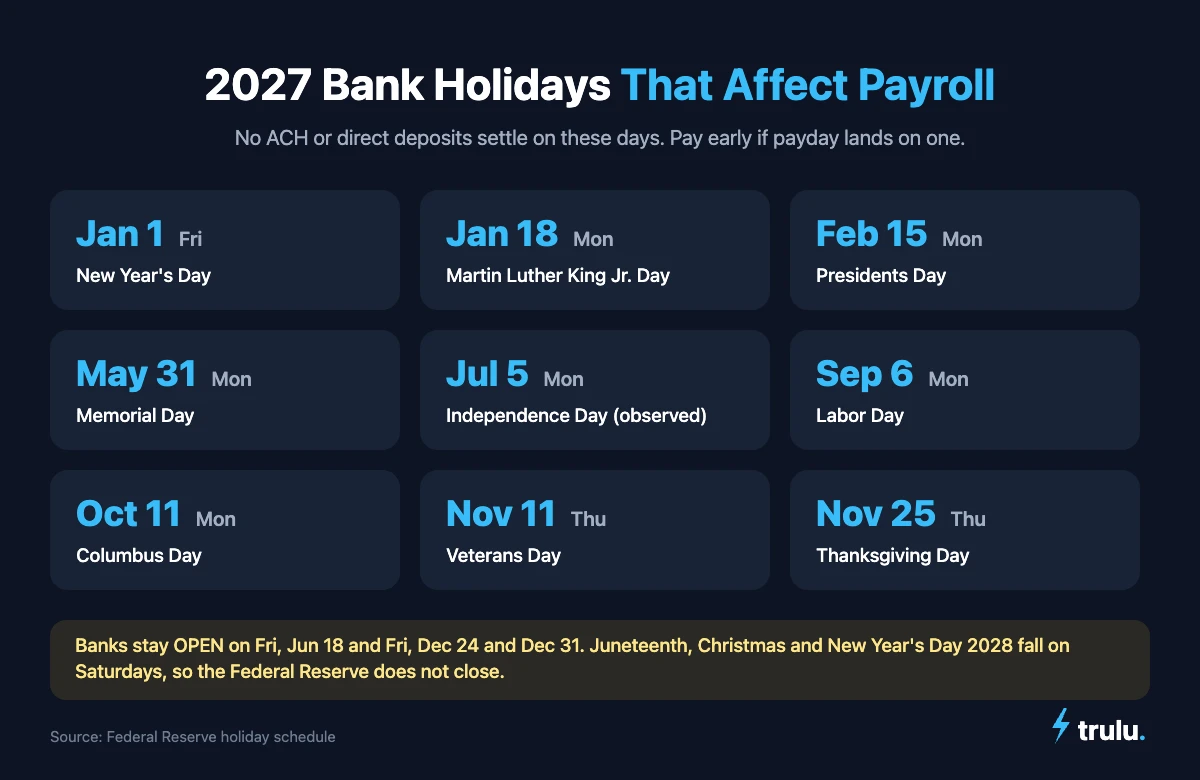
| Holiday | 2027 date | Banks closed? |
|---|---|---|
| New Year’s Day | Fri, Jan 1 | Yes |
| Martin Luther King Jr. Day | Mon, Jan 18 | Yes |
| Presidents Day (Washington’s Birthday) | Mon, Feb 15 | Yes |
| Memorial Day | Mon, May 31 | Yes |
| Juneteenth | Sat, Jun 19 | No weekday closure (open Fri, Jun 18) |
| Independence Day | Sun, Jul 4 | Yes, observed Mon, Jul 5 |
| Labor Day | Mon, Sep 6 | Yes |
| Columbus Day / Indigenous Peoples’ Day | Mon, Oct 11 | Yes |
| Veterans Day | Thu, Nov 11 | Yes |
| Thanksgiving Day | Thu, Nov 25 | Yes |
| Christmas Day | Sat, Dec 25 | No weekday closure (open Fri, Dec 24) |
Keep in mind that federal employees get Friday, June 18, Friday, December 24 and Friday, December 31 off, but banks don’t. If your business closes on those days, run payroll early so it doesn’t slip.
2027 payroll tax deadlines
Your 2027 payroll calendar should also track federal filing dates. When a due date falls on a weekend or legal holiday, the IRS employment tax due dates move to the next business day, which shifts several deadlines in 2027.
| Deadline | What’s due |
|---|---|
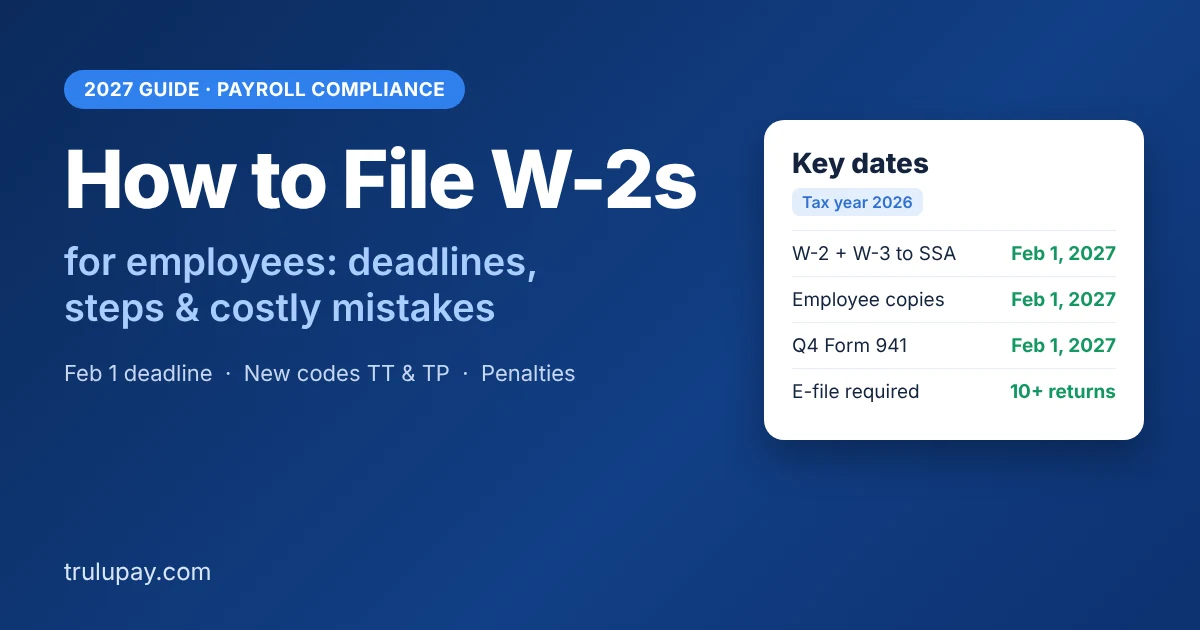
| Mon, Feb 1, 2027 | Form 941 for Q4 2026; Form 940 for 2026; W-2s to employees and SSA; Form W-3; 1099-NEC |
| Fri, Apr 30, 2027 | Form 941 for Q1 2027; FUTA deposit for Q1 (if over $500) |
| Mon, Aug 2, 2027 | Form 941 for Q2 2027 (July 31 is a Saturday); FUTA deposit for Q2 |
| Mon, Nov 1, 2027 | Form 941 for Q3 2027 (October 31 is a Sunday); FUTA deposit for Q3 |
| Mon, Jan 31, 2028 | Form 941 for Q4 2027; Form 940 for 2027; 2027 W-2s and W-3 |
Federal tax deposits follow their own rhythm. Monthly depositors pay by the 15th of the following month. Semiweekly depositors deposit by the next Wednesday for paydays Wednesday through Friday, and by the next Friday for paydays Saturday through Tuesday. Your deposit schedule is based on a lookback period explained in IRS Publication 15.
How to handle 27 pay periods in 2027
If Schedule A of the 2027 payroll calendar matches your business, plan for the extra payday now. Hourly employees are simple: you pay for the hours worked. Salaried employees and benefit deductions take more thought.
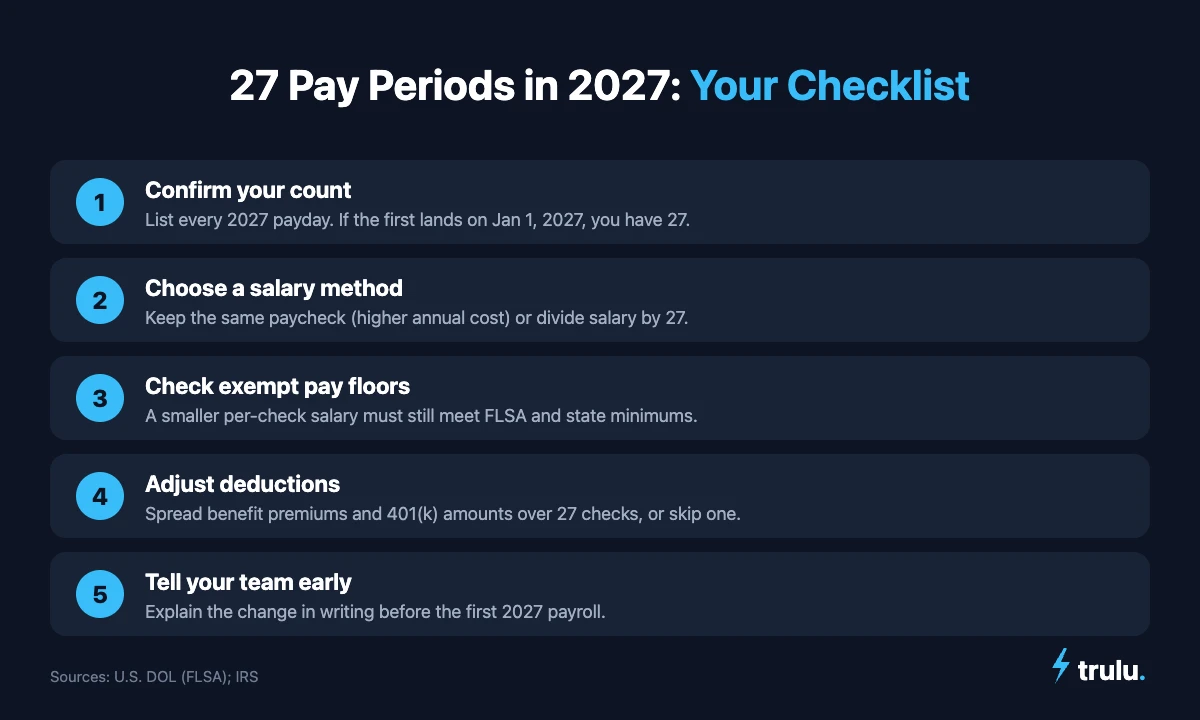
1. Choose how to pay salaried employees
You have two common options:
- Keep paychecks the same. Employees get their usual amount 27 times. This is easiest to explain, but it raises your annual payroll cost by about 3.8% for those employees (one extra check out of 26).
- Divide annual salary by 27. Your yearly cost stays flat, but each paycheck shrinks slightly. Tell employees in writing before the first pay run of 2027 so nobody is surprised.
2. Check exempt salary minimums
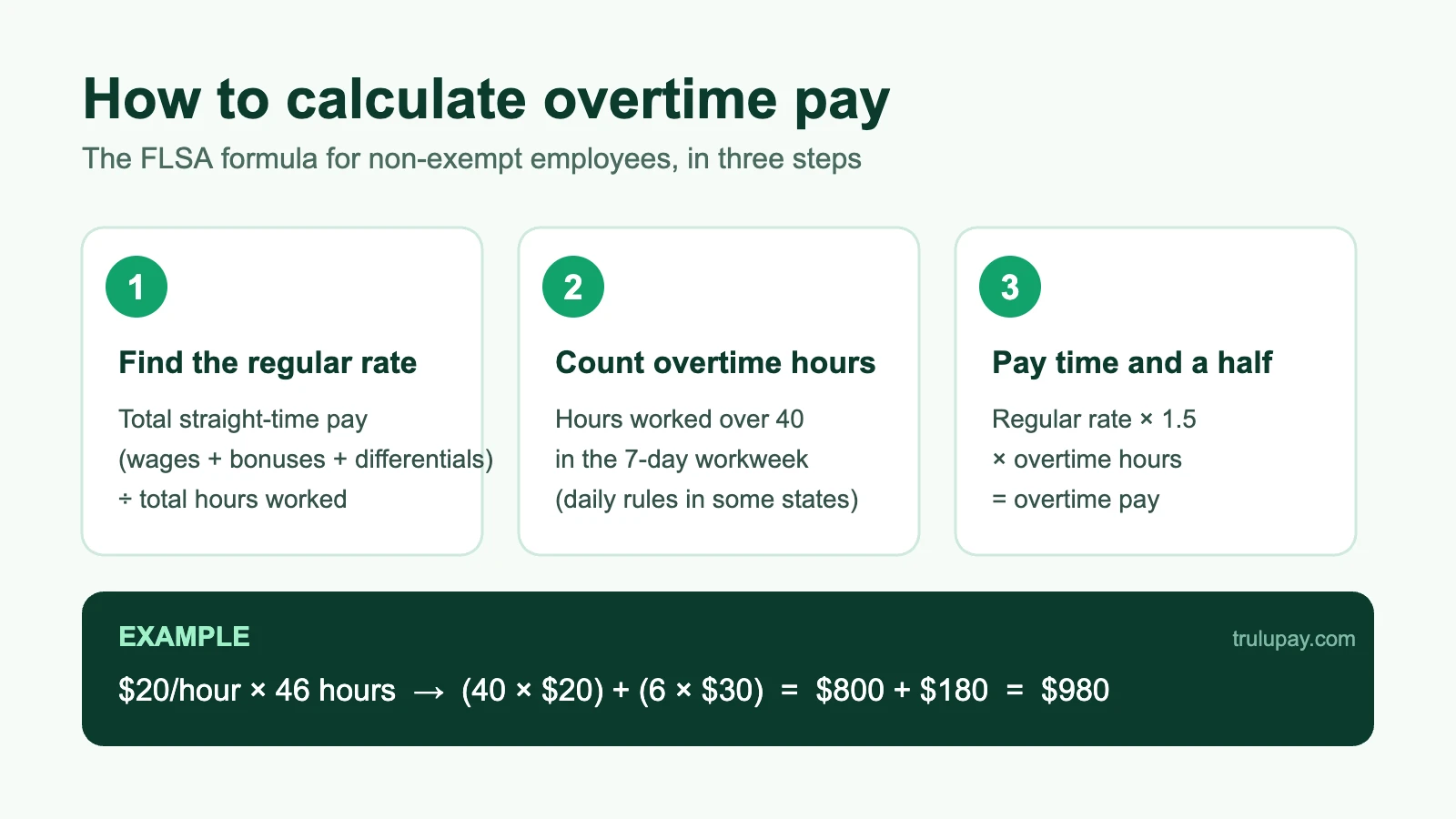
If you divide salaries by 27, make sure each paycheck still meets the federal salary threshold for exempt employees under the Fair Labor Standards Act, plus any higher state threshold. Falling below it can make an exempt employee eligible for overtime.
3. Recalculate benefit and retirement deductions
Per-paycheck deductions for health premiums, FSAs and 401(k) contributions are usually set for 26 pay periods. Either recalculate them over 27 checks or skip deductions on the 27th paycheck. Watch employees who contribute a flat amount per check so they don’t hit annual 401(k) limits early.
4. Budget for the cash flow
With biweekly payroll, some months have three paydays instead of two. In Schedule A, July and December each have three. In Schedule B, April and October do. Set aside cash for those months.
5. Communicate early
Send a short note to your team in November or December explaining your 2027 payroll calendar, the extra payday and any change to per-check amounts. Clear communication prevents most payroll questions before they start.
How to choose a pay schedule for 2027
If you’re setting up payroll for the first time, or thinking about switching schedules, weigh these factors:
- State pay frequency laws. Many states require nonexempt employees to be paid at least twice a month. Check the U.S. Department of Labor’s state payday requirements before choosing monthly payroll.
- Admin time. Weekly payroll means 52 or 53 runs a year. Semimonthly means 24, but overtime is harder to calculate because periods don’t line up with workweeks.
- Employee expectations. Hourly teams often prefer weekly or biweekly pay. Salaried teams are usually fine with semimonthly.
- Switching mid-year. Changing schedules often requires advance notice to employees under state law, so the start of a new year is the cleanest time to switch.
How to build your own 2027 payroll calendar in 5 steps
- Pick your frequency and payday weekday. For example, biweekly on Fridays.
- Set your first 2027 payday and count forward to list every payday through December 31.
- Mark bank holidays and weekends and move affected paydays to the previous business day.
- Add processing deadlines based on your provider’s cutoff, usually one to two banking days before payday.
- Layer in tax deadlines such as Form 941 due dates and your deposit schedule, then share the finished 2027 payroll calendar with everyone who approves time or expenses.
Automate your 2027 payroll calendar with Trulu
A spreadsheet calendar works until a holiday moves a deadline or a timesheet changes after you’ve closed the period. Trulu builds your payroll calendar for you, with bank-holiday-aware deadlines, a countdown to each pay run and reminders when something needs your approval. Set up your 2027 payroll calendar once and Trulu keeps every date current. Approved timesheets, PTO and expenses flow into the next payroll on their own, so you run payroll in three steps instead of chasing numbers.
Comparing tools? Read our HR and payroll software buyer’s guide for small businesses. Or sign up for Trulu and get your first 4 months free, with no credit card needed.
Frequently asked questions about the 2027 payroll calendar
Are there 27 pay periods in 2027?
Only for some employers. If you pay biweekly on Fridays and your first payday of 2027 is January 1, you have 27 pay periods. If your first Friday payday is January 8, you have 26. Weekly employers paying on Friday have 53.
How many biweekly pay periods are in 2027?
Most biweekly employers have 26 pay periods in 2027. Employers with a Friday payday that falls on January 1, 2027 have 27.
What happens if payday falls on a holiday in 2027?
Pay employees on the business day before the holiday. For example, a January 1, 2027 payday should be paid on Thursday, December 31, 2026, because banks are closed on New Year’s Day.
Is Juneteenth a bank holiday in 2027?
Juneteenth falls on Saturday, June 19, 2027. The Federal Reserve does not close on the Friday before a Saturday holiday, so direct deposits process normally on Friday, June 18.
When are W-2s due in 2027?
W-2s for 2026 are due to employees and the Social Security Administration by Monday, February 1, 2027, because January 31 falls on a Sunday.
What is the best pay schedule for a small business?
Biweekly is the most popular choice because it lines up with weekly overtime rules and gives employees a predictable payday. Semimonthly works well for salaried teams. Always confirm your state’s minimum pay frequency first.